Why Are Some of My Categories Not Being Uploaded on Woocommerce
Product categories ↑ Back to summit
Production categories are the principal way to grouping products with similar features. You can besides add subcategories if desired.
For case, if you sell clothing, you might have "t-shirts", "hoodies" and "pants" as categories.
How to add/edit product categories ↑ Back to top
Categories are managed from the Products > Categories screen.
Like to categories on your posts in WordPress, you can add together, delete, and edit product categories.
- Add a Proper name.
- Add a Slug(optional); this is the URL-friendly version of the name.
- Choose a Parent if this is a subcategory.
- Enter a Clarification (optional); some themes display this.
- Choose the Display blazon. Decide what is shown on the category'southward landing page. "Standard" uses your theme'southward default. "Subcategories" will brandish only the subcategories. "Products" only displays products. "Both" will display subcategories and products below that.
- Upload/Add together Image (optional); Some themes have pages where product category images are displayed, and so this is a expert idea.
Storefront by default displays product category images on the homepage template.

Categories can besides be reordered past dragging and dropping – this order is used by default on the front end whenever the categories are listed. This includes both widgets and the category/subcategory views on product pages.
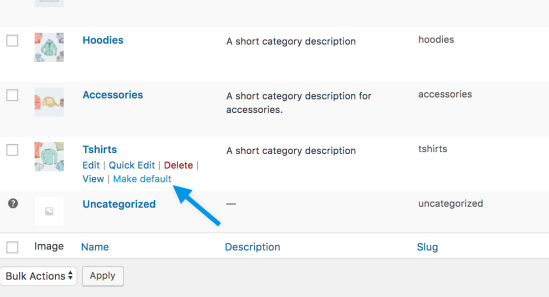
Since WooCommerce 3.3, in that location volition be a default category. Every production must exist assigned to a category, and then the default category will exist automatically assigned if the production is not assigned to whatsoever other category. By default, this category will be named "Uncategorized" and can not be deleted. However, you can rename the category. Y'all tin can likewise switch the default category using the row deportment underneath the category name, and then the "Uncategorized" category can be deleted as it is no longer the default.
When you add together a new product viaProducts > Add Product, you tin can select this new product category from the list.
Alternatively, y'all tin can go to Products > Add together Product straight, and select Add New Product Category.

The taxonomy is product_cat. And the filtering feature becomes AJAX-enabled for friendlier utilize once there are 100 categories.
Production tags ↑ Back to top
What are product tags? ↑ Back to tiptop
Product tags are another way to relate products to each other, side by side to product categories. Contrary to categories, there is no hierarchy in tags; so there areno "subtags."
For example, if you sell clothing, and you have a lot of cat prints, you could make a tag for "true cat." Then add that tag to the menu or sidebar and then cat lovers can hands find all t-shirts, hoodies, and pants with cat prints.
How to add/edit product tags ↑ Dorsum to top
Tags can be added similarly to adding product categories and work in exactly the same mode as mail service tags. See the WordPress.org Codex for more than data.
The taxonomy is product_tag.
Product attributes ↑ Back to top
What are product attributes? ↑ Back to top
A 3rd and important way to group products is to use attributes. There are ii uses of this data blazon that are relevant for WooCommerce:
- First is via WooCommerce widgets. "Filter Products by Attribute" allows y'all to select a specific attribute. If you lot add this widget to your sidebar, customers tin filter products in your store based on the aspect.

- 2nd is via variable products. To create a variable product, an aspect must start be divers for the product. These attributes can and so be used to make a distinction between different variations. More info at: Variable Products.
For example, if y'all're selling clothing, two logical attributes are "color" and "size", so people can search across categories for a color that fits their style and blazon and clothing available in their size.
How to add together/edit product attributes ↑ Back to acme
Set up global attributes
Get to Products > Attributesto add, edit, and remove attributes.
Here you tin quickly and hands add attributes and their terms.
SelectAdd together Attribute.
The attribute is added in the table on the right, but without values.
Select the "Configure terms" text to add attribute values.

NextAdd New "Attribute name", where "Attribute name" automatically takes the name you gave the attribute in the previous step.
Add equally many values as you wish. If you selected "Custom ordering" for the attribute, reordering your values can exist done here.
Add global attributes to product
Add the created attributes to your products.
- Go to: Products > Add Product (or edit an existing one).
- Select the Attributes tab in the Product Data. There you tin can choose any of the attributes that you've created in the dropdown menu.
- Select Add.
If yous selected a global attribute that y'all previously created, you can select terms that you lot added previously.
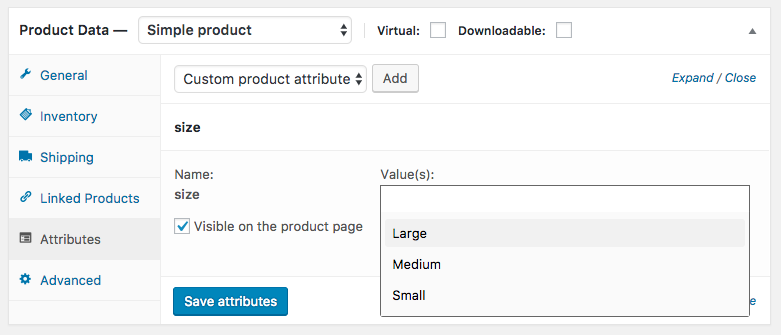
Add custom attributes
Alternatively, add together an aspect you just want to use for one product. This would only be platonic if you have a product with unique variations.
- Become to: Product > Add Product.
- Select the Attributestab.
- Select Custom product aspect in the dropdown and follow the above steps.
Questions ↑ Back to acme
Have a question or demand some help? Paying customers can arrive affect with a Happiness Engineer via the Assistance Desk-bound.
Source: https://woocommerce.com/document/managing-product-taxonomies/
0 Response to "Why Are Some of My Categories Not Being Uploaded on Woocommerce"
Post a Comment