Can a Baby Have a Heart Defect Without Being Detected by a Stethoscope
Contents
- What is center hurting ?
-
- Heart pain symptoms
- Causes of heart pain
- Plaque Buildup in an Artery
- Risk for Angina
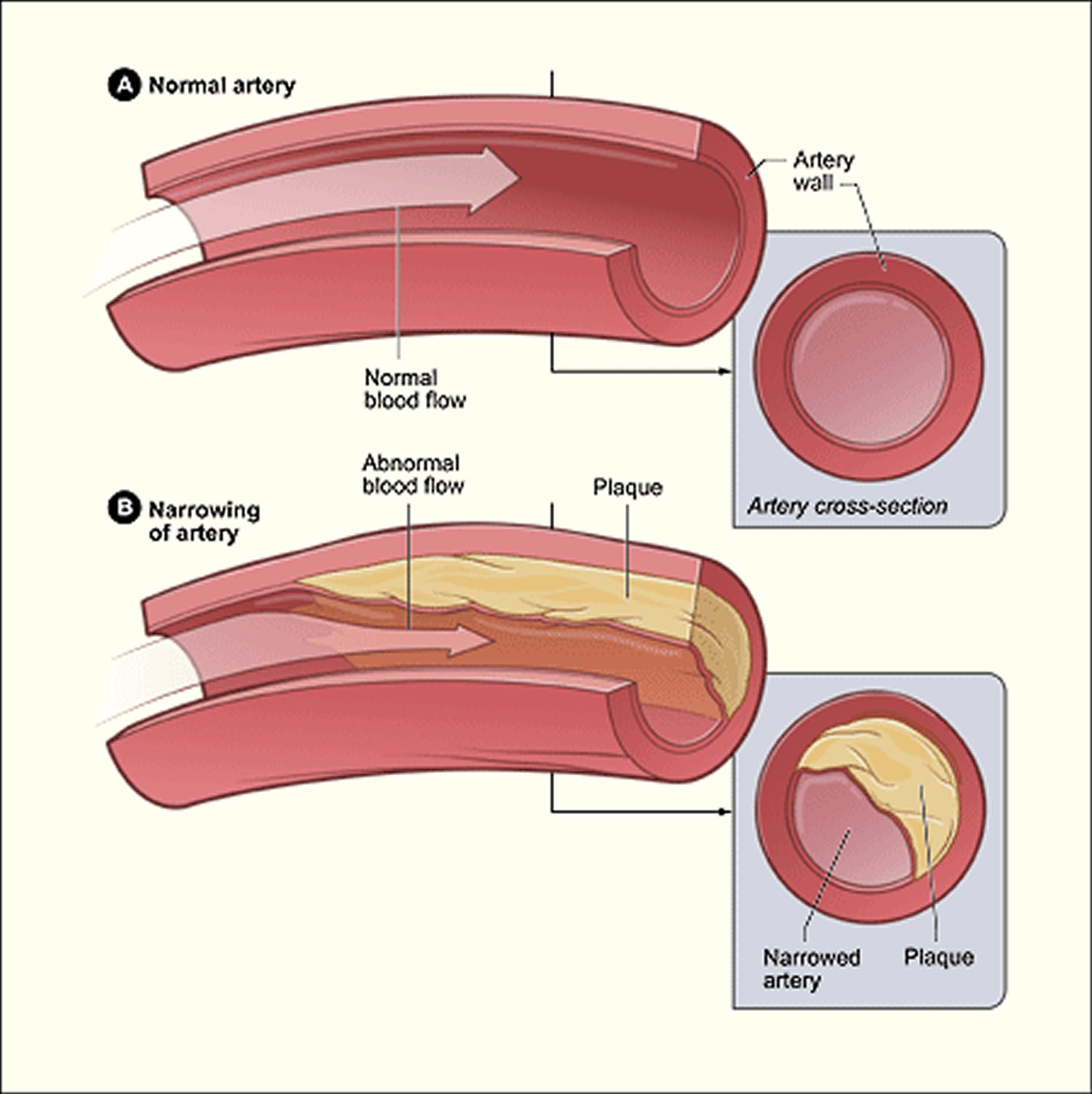
- Figure ane. Atherosclerosis plaque
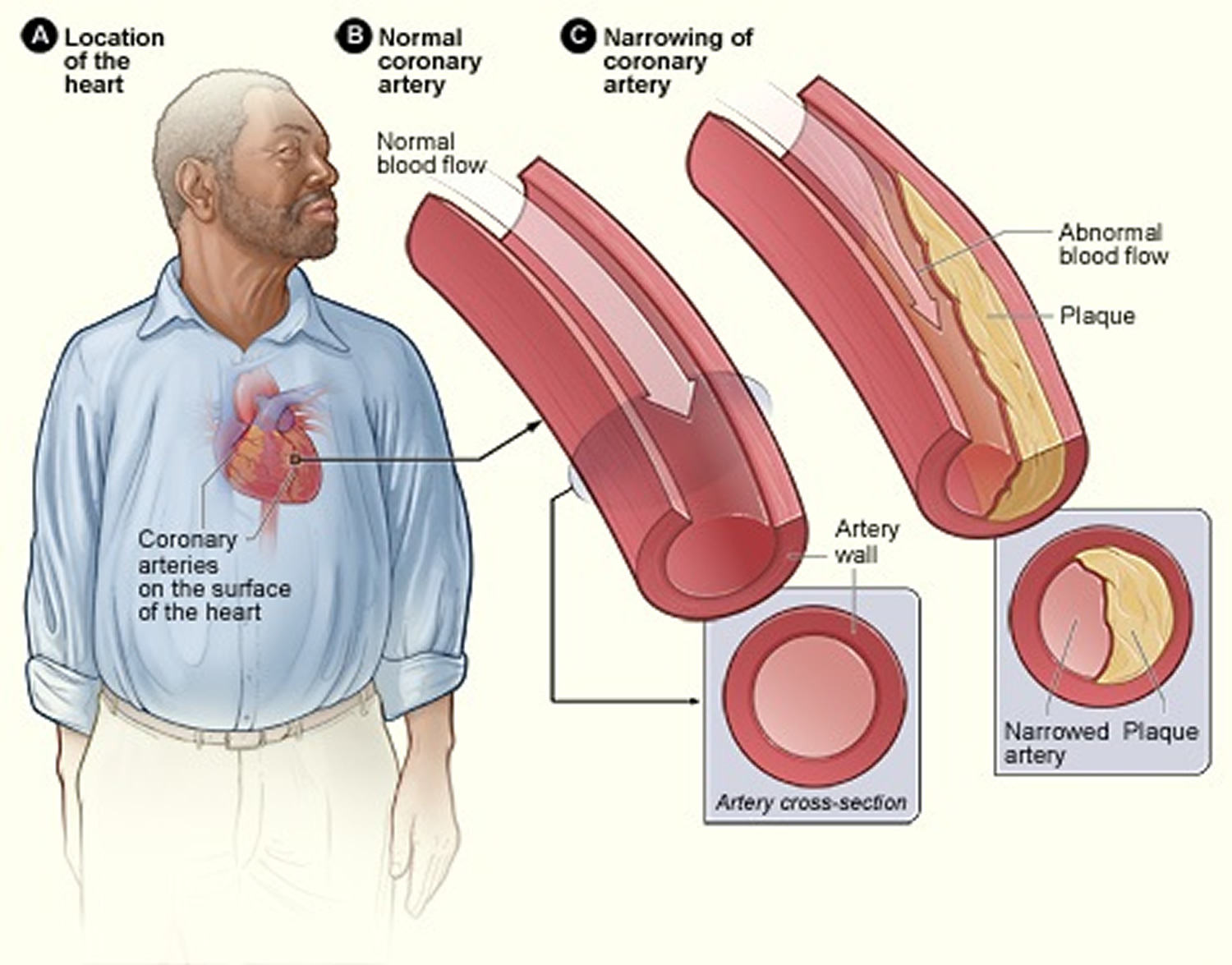
- Figure 2. Atherosclerosis blocking the coronary artery in your center
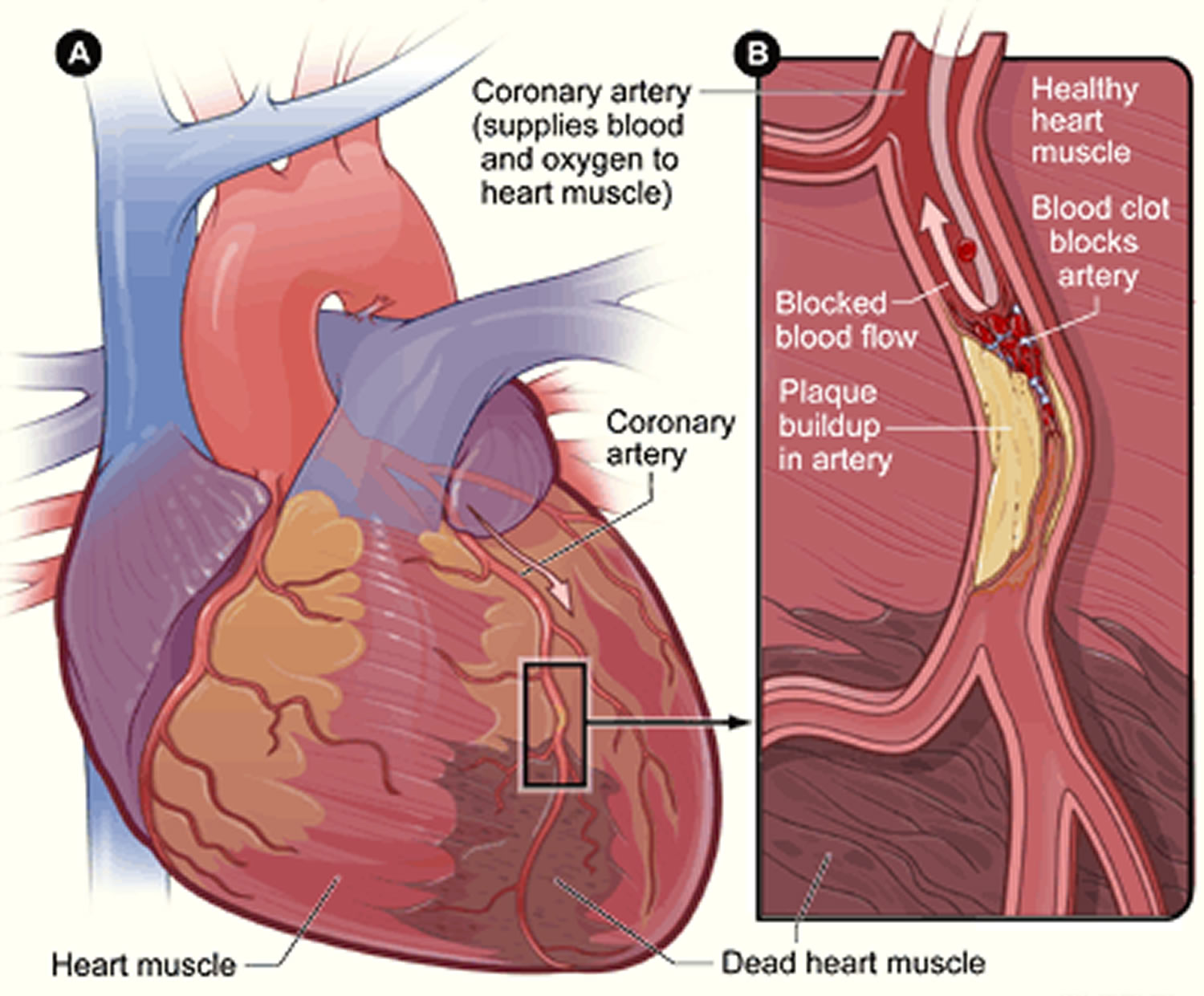
- Effigy three. Heart With Muscle Damage and a Blocked Left Coronary Avenue
- Types of Angina
- Stable Angina
- Symptoms of Stable Angina – The pain or discomfort:
- Possible triggers of stable angina include:
- Handling of Stable Angina
- Unstable Angina
- Symptoms of Unstable Angina – The pain or discomfort 1) :
- Handling for Unstable Angina
- Variant (Prinzmetal'south) Angina
- Causes of Variant (Prinzmetal) Angina:
- Symptoms of Variant (Prinzmetal) Angina:
- Treatment of Variant Angina (Prinzmetal's Angina)
- Microvascular Angina
- Causes of microvascular angina:
- Symptoms of microvascular angina:
- Coronary Microvascular Illness
- What Causes Coronary Microvascular Illness ?
- Understand Your Risk for Coronary Microvascular Disease ?
- What Are the Signs and Symptoms of Coronary Microvascular Disease ?
- Diagnosis of Coronary Microvascular Illness
- Diagnostic Tests for Coronary Microvascular Disease
- Treatment of Coronary Microvascular Affliction
- Prevention of Coronary Microvascular Disease
- Angina in Women
- What Is Pulmonary Embolism ?
- Outlook for Pulmonary embolism
- What is Aortic Autopsy
- Causes of Aortic dissection
- Symptoms of Aortic Dissection
- Exams and Tests for Aortic Autopsy
- Treatment of Aortic Dissection
- Outlook (Prognosis) for Aortic Dissection
- Possible Complications of Aortic Autopsy
- What is Aortic Valve Stenosis
- Causes of Aortic Stenosis
- Symptoms of Aortic Stenosis
- Exams and Tests forAortic Stenosis
- Treatment of Aortic Stenosis
- Outlook (Prognosis) of Aortic Stenosis
- Ongoing Care for Aortic Stenosis
- What is Hypertrophic cardiomyopathy
- Causes of Hypertrophic cardiomyopathy
- Symptoms of Hypertrophic cardiomyopathy
- Exams and Tests for Hypertrophic cardiomyopathy
- Handling for Hypertrophic cardiomyopathy
- Outlook (Prognosis) for Hypertrophic cardiomyopathy
- What is Pericarditis
- Causes of Pericarditis
- Symptoms of Pericarditis
- Exams and Tests for Pericarditis
- Treatment for Pericarditis
- Outlook (Prognosis) for Pericarditis
- What is Panic Set on
- Causes of Panic Disorder
- Symptoms of Panic assault
- Exams and Tests for Panic attack
- Treatment for Panic attack
- Support Groups for Panic Attack and Panic Disorder
- Stable Angina
-
What is heart pain ?
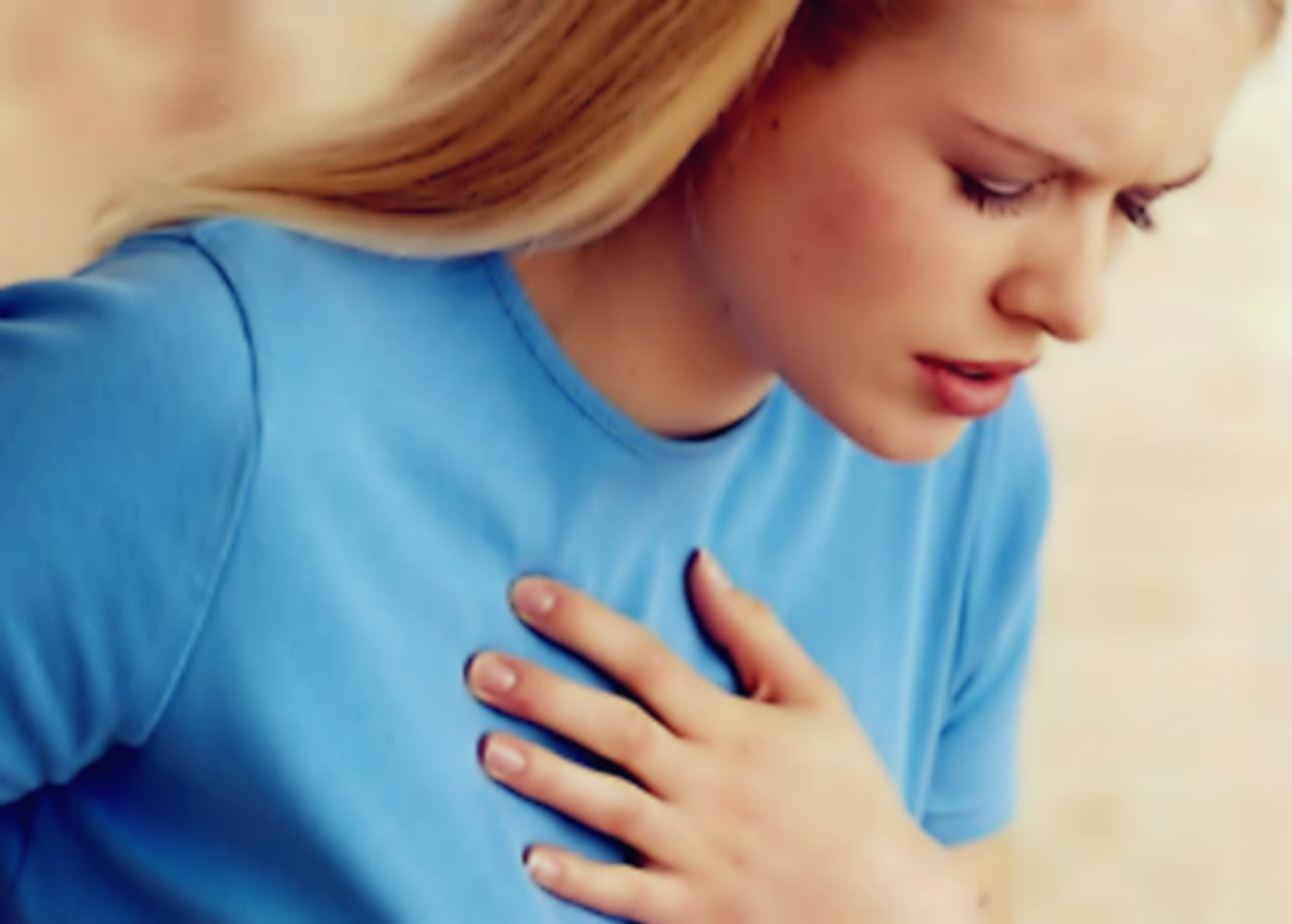
Eye pain or angina is chest pain or discomfort caused when your heart musculus doesn't become enough oxygen-rich claret two) . It may feel like pressure level or squeezing in your chest 3) . The discomfort also tin occur in your shoulders, arms, neck, jaw, or back. Angina hurting may even feel similar indigestion 4) .
Only, angina is not a illness. Center hurting or angina is a symptom of an underlying eye trouble, usually coronary heart disease (coronary artery illness). In that location are many types of angina, including microvascular angina, Prinzmetal'due south angina, stable angina, unstable angina and variant angina.
Coronary center disease (coronary artery illness) is the most common type of eye disease in adults. Information technology occurs if a waxy substance called plaque builds up on the inner walls of your coronary arteries. These arteries carry oxygen-rich blood to your middle. Eye pain or angina usually happens because one or more of the coronary arteries is narrowed or blocked, too chosen ischemia.
Experts believe that nearly 7 one thousand thousand people in the The states suffer from angina 5) . The condition occurs equally among men and women 6) .
Angina tin be a sign of coronary eye illness (coronary artery disease), even if initial tests don't betoken to the illness. However, not all chest pain or discomfort is a sign of coronary heart affliction (coronary artery illness) 7) .
Heart pain symptoms
Pain and discomfort are the main symptoms of angina. Angina often is described as pressure, squeezing, burning, or tightness in the chest. The pain or discomfort ordinarily starts behind the breastbone.
Pain from angina also can occur in the arms, shoulders, neck, jaw, throat, or back. The pain may feel like indigestion. Some people say that angina hurting is hard to describe or that they can't tell exactly where the pain is coming from.
Signs and symptoms such as nausea (feeling ill to your stomach), fatigue (tiredness), shortness of jiff, sweating, light-headedness, and weakness also may occur.
Women are more likely to experience discomfort in the cervix, jaw, pharynx, abdomen, or back. Shortness of breath is more mutual in older people and those who have diabetes. Weakness, dizziness, and confusion can mask the signs and symptoms of angina in elderly people.
Symptoms also vary based on the type of angina you have.
Because angina has so many possible symptoms and causes, all chest pain should be checked by a doctor. Chest pain that lasts longer than a few minutes and isn't relieved by rest or angina medicine may be a sign of a heart attack. Call your local emergency number right away.
Stable Angina
The hurting or discomfort:
- Occurs when the heart must work harder, usually during concrete exertion
- Doesn't come as a surprise, and episodes of hurting tend to be alike
- Usually lasts a short time (5 minutes or less)
- Is relieved by rest or medicine
- May feel like gas or indigestion
- May feel like chest hurting that spreads to the arms, dorsum, or other areas
Unstable Angina
The pain or discomfort:
- Often occurs at remainder, while sleeping at night, or with footling physical exertion
- Comes every bit a surprise
- Is more severe and lasts longer than stable angina (every bit long as 30 minutes)
- Commonly isn't relieved past residue or medicine
- May get worse over fourth dimension
- May mean that a heart attack will happen soon
Variant Angina
The pain or discomfort:
- Normally occurs at balance and during the nighttime or early morning hours
- Tends to be severe
- Is relieved by medicine
Microvascular Angina
The pain or discomfort:
- May be more astringent and last longer than other types of angina pain
- May occur with shortness of breath, sleep issues, fatigue, and lack of energy
- Ofttimes is starting time noticed during routine daily activities and times of mental stress
Causes of heart pain
Angina usually is a symptom of coronary eye disease (coronary artery disease). This means that the underlying causes of angina more often than not are the same as the underlying causes of coronary heart disease (coronary avenue illness).
Research suggests that coronary centre affliction (coronary artery disease) starts when certain factors damage the inner layers of the coronary arteries. These factors include:
- Smoking
- Loftier amounts of certain fats and cholesterol in the blood
- High blood pressure
- High amounts of sugar in the blood due to insulin resistance or diabetes
Plaque may begin to build up where the arteries are damaged. When plaque builds up in the arteries, the condition is chosen atherosclerosis. Plaque narrows or blocks the arteries, reducing blood flow to the heart muscle. Some plaque is hard and stable and causes the arteries to go narrow and potent. This can greatly reduce blood flow to the heart and cause angina. Other plaque is soft and more than probable to rupture (break open up) and crusade blood clots. Blood clots can partially or totally cake the coronary arteries and cause angina or a heart attack.
Other conditions as well can cause chest pain, such as eight) :
- Pulmonary embolism (a blockage in a lung artery)
- A lung infection
- Aortic dissection (vehement of a major artery)
- Aortic stenosis (narrowing of the heart's aortic valve)
- Hypertrophic cardiomyopathy (heart muscle disease)
- Pericarditis (inflammation in the tissues that surround the heart)
- A panic attack
All chest pain should be checked past a doctor !
Plaque Buildup in an Artery
Plaque is made upward of fat, cholesterol, calcium, and other substances found in the claret. Over time, plaque hardens and narrows your arteries. This limits the flow of oxygen-rich blood to your organs and other parts of your body.
When plaque builds up in the arteries, the status is called atherosclerosis. Atherosclerosis tin lead to serious issues, including middle attack, stroke, or even decease.
Atherosclerosis is a disease in which plaque builds up within your arteries. The buildup of plaque occurs over many years.
Atherosclerosis plaque narrows the coronary arteries and reduces blood flow to your heart muscle. Plaque narrows and stiffens the coronary arteries. This reduces the flow of oxygen-rich blood to the heart muscle, causing chest pain.
Plaque buildup also makes it more probable that blood clots will form in your arteries. Blood clots can partially or completely block blood catamenia, which can crusade a heart attack.
- If blood menses to your heart muscle is reduced or blocked, y'all may take angina (chest hurting or discomfort) or a heart set on.
When plaque narrows and stiffens the coronary arteries. This reduces the period of oxygen-rich blood to the heart muscle, causing breast pain. Plaque buildup also makes it more likely that claret clots volition form in your arteries. Blood clots tin can partially or completely cake blood period, which tin can cause a middle assail.
Angina also tin can be a symptom of coronary microvascular disease. This disease is called coronary microvascular disease. In coronary microvascular illness, plaque doesn't crusade blockages in the arteries as information technology does in coronary heart disease. Studies accept shown that coronary microvascular disease is more likely to affect women than men. Coronary microvascular disease likewise is called cardiac syndrome X and nonobstructive coronary heart affliction.
Risk for Angina
If you're at risk for eye affliction or coronary microvascular illness, you're likewise at take chances for angina. The major risk factors for heart affliction and coronary microvascular disease include:
- Unhealthy cholesterol levels
- Loftier blood force per unit area
- Smoking
- Diabetes
- Overweight or obesity
- Metabolic syndrome
- Inactivity
- Unhealthy diet
- Older historic period (The adventure increases for men after 45 years of historic period and for women after 55 years of age.)
- Family history of early heart affliction
Figure i. Atherosclerosis plaque
[Source 9) ]
Figure ii. Atherosclerosis blocking the coronary artery in your heart
[Source 10) ]
Figure iii. Centre With Muscle Damage and a Blocked Left Coronary Artery
[Source xi) ]
Types of Angina
The major types of angina are stable, unstable, variant (Prinzmetal'due south), and microvascular. Knowing how the types differ is important. This is because they have different symptoms and require dissimilar treatments.
Stable Angina
Stable angina (angina pectoris) is the most common type of angina 12) . It occurs when the centre is working harder than usual thirteen) . Angina often occurs when the center musculus itself needs more blood than it is getting, for instance, during times of physical activeness or strong emotions 14) . Severely narrowed arteries may permit plenty blood to attain the heart when the demand for oxygen is low, such every bit when you're sitting. But, with physical exertion—like walking up a loma or climbing stairs—the eye works harder and needs more than oxygen.
Stable angina has a regular design. ("Design" refers to how often the angina occurs, how severe information technology is, and what factors trigger information technology.)
If y'all have stable angina, you tin can learn its pattern and predict when the pain will occur. The pain normally goes away a few minutes after y'all rest or take your angina medicine 15) .
Stable angina isn't a heart attack, just it suggests that a center set on is more likely to happen in the future.
Symptoms of Stable Angina – The pain or discomfort:
- Occurs when the center must work harder, usually during physical exertion
- Doesn't come as a surprise, and episodes of hurting tend to exist akin
- Usually lasts a curt time (5 minutes or less)
- Is relieved by rest or medicine
- May feel similar gas or indigestion
- May feel like chest hurting that spreads to the arms, back, or other areas
Possible triggers of stable angina include:
- Emotional stress – larn stress management
- Exposure to very hot or common cold temperatures – acquire how cold and hot weather affect the heart.
- Heavy meals
- Smoking.
Treatment of Stable Angina
People with stable angina or sometimes referred to every bit angina pectoris have episodes of chest pain. The discomfort that are commonly anticipated and manageable. Y'all might experience it while running or if y'all're dealing with stress.
Ordinarily this blazon of chest discomfort is relieved with rest, nitroglycerin or both. Nitroglycerin relaxes the coronary arteries and other blood vessels, reducing the corporeality of blood that returns to the heart and easing the eye'due south workload. By relaxing the coronary arteries, it increases the eye'south blood supply.
If you experience chest discomfort, be sure and visit your medico for a complete evaluation and, perchance, tests. If you take stable angina and start getting chest hurting more easily and more oftentimes, run into your physician immediately equally you may be experiencing early signs of unstable angina.
Unstable Angina
Unstable angina, sometimes referred to as astute coronary syndrome causes unexpected chest pain, doesn't follow a pattern 16) . It may occur more than often and exist more severe than stable angina. Unstable angina also tin can occur with or without physical exertion, and residue or medicine may not relieve the pain.
The most mutual cause is reduced blood flow to the center muscle because the coronary arteries are narrowed past fat buildups (atherosclerosis) which can rupture causing injury to the coronary blood vessel resulting in blood clotting which blocks the flow of blood to the middle muscle.
Unstable angina should exist treated equally an emergency. If you lot have new, worsening or persistent chest discomfort, you need to become to the emergency department. You could be having a heart attack which puts you at increased take chances for severe cardiac arrhythmias or cardiac arrest, which could lead to sudden decease.
- Unstable angina is very dangerous and requires emergency treatment. This blazon of angina is a sign that a heart attack may happen soon.
Causes of Unstable Angina: Blood clots that cake an artery partially or totally are what causes unstable angina. Claret clots may grade, partially dissolve, and later class again and angina tin can occur each time a clot blocks blood menses in an artery. Larn more about excessive claret clotting.
Symptoms of Unstable Angina – The pain or discomfort 17) :
- Often occurs while you may be resting, sleeping, or with lilliputian physical exertion
- Comes as a surprise
- May concluding longer than stable angina
- Rest or medicine normally do non assistance relieve it
- May become worse over fourth dimension
- Can lead to a heart attack
Handling for Unstable Angina
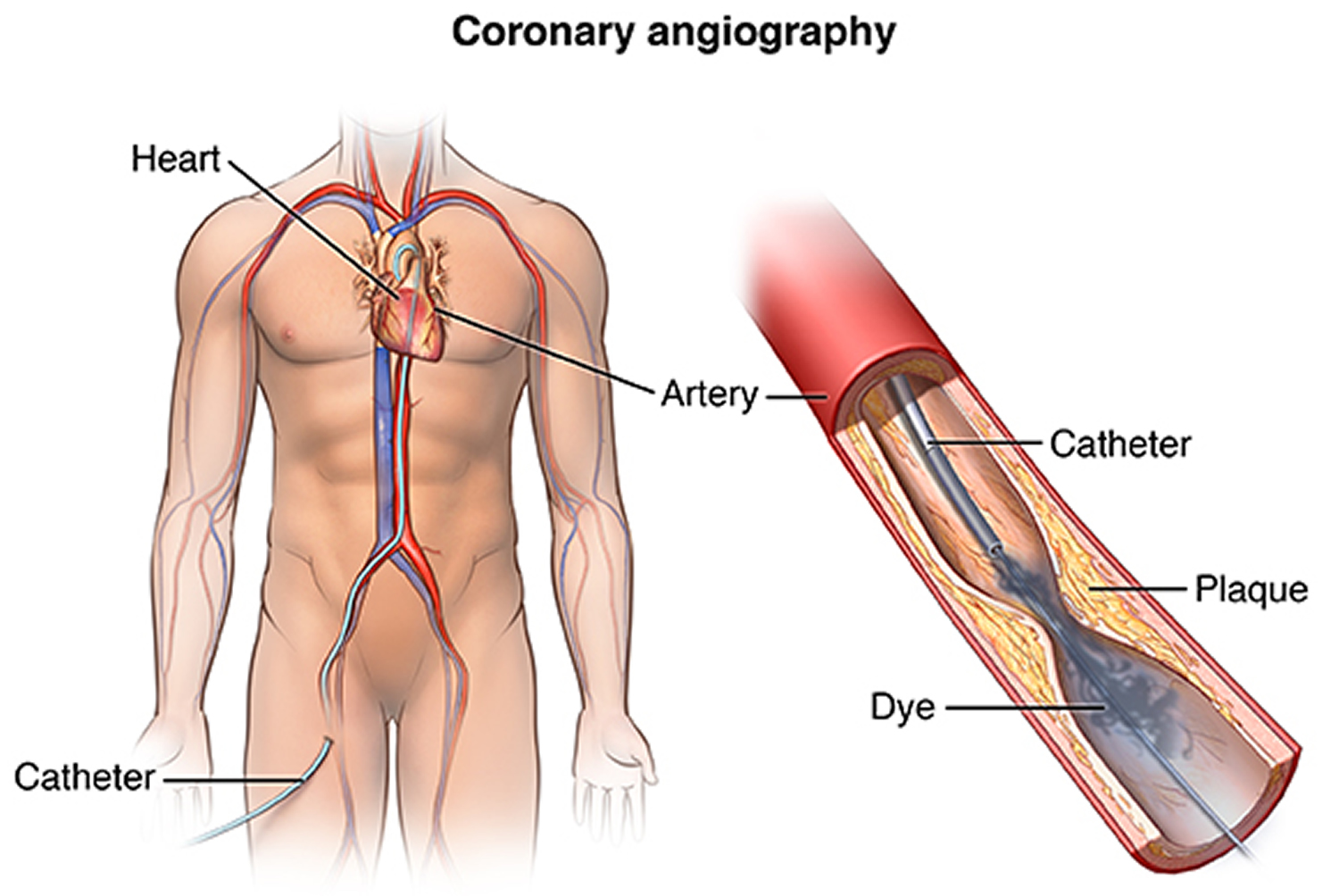
Showtime, your healthcare provider will demand to find the blocked part or parts of the coronary arteries by performing a cardiac catheterization. In this procedure, a catheter is guided through an artery in the arm or leg and into the coronary arteries, and so injected with a liquid dye through the catheter. High-speed X-ray movies record the class of the dye every bit information technology flows through the arteries, and doctors can identify blockages by tracing the flow. An evaluation of how well your heart is working also can be done during cardiac catheterization.
Figure 4. Cardiac Catheterization
Next, based on the extent of the coronary artery blockage(s) your doctor will hash out with you the post-obit treatment options:
- Percutaneous coronary intervention (heart stent surgery) may exist required to open up a blocked coronary artery. Briefly, this procedure involves undergoing cardiac catheterization followed by using a catheter with a small inflatable balloon at the tip. The balloon is inflated, squeezing open the fat plaque deposit located on the inner lining of the coronary artery. Then the airship is deflated and the catheter is withdrawn. This procedure is ofttimes followed past insertion of a stent to then keep the coronary artery vessel propped open up to permit for improved blood flow to the heart muscle.
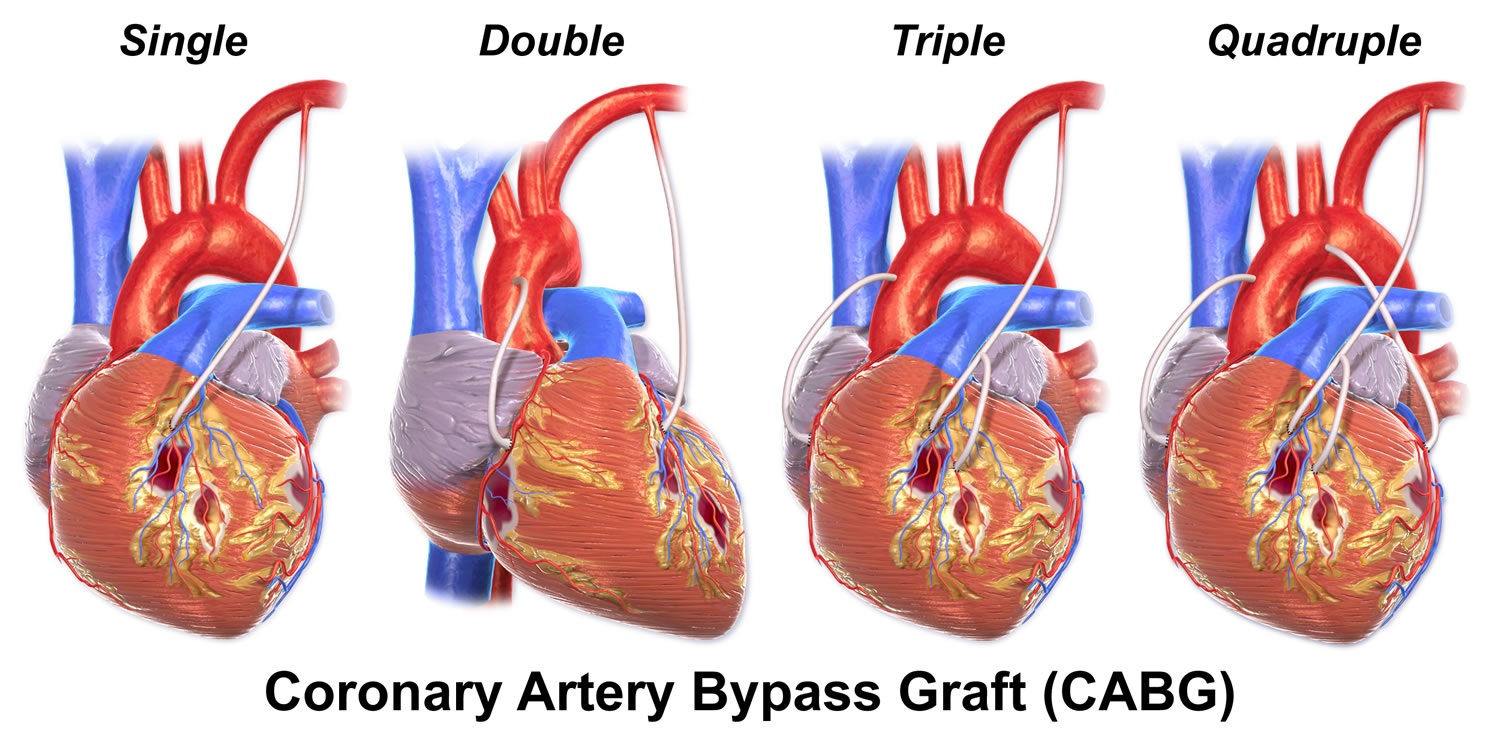
- Coronary artery featherbed graft surgery may be indicated depending on the extent of coronary artery blockages and medical history. In this process, a blood vessel is used to road blood around the blocked part of the artery, forming a kind of detour.
Before any of these procedures, a doctor must find the blocked part or parts of the coronary arteries. He or she will guide a catheter through an artery in the arm or leg and into the coronary arteries, then inject a liquid dye through the catheter. High-speed 10-ray movies record the form of the dye as it flows through the arteries, and doctors can identify blockages by tracing the flow. An evaluation of how the heart works also tin can be done during cardiac catheterization.
For more than information, talk to your doctor.
Effigy 5. Heart stent surgery (percutaneous coronary intervention)
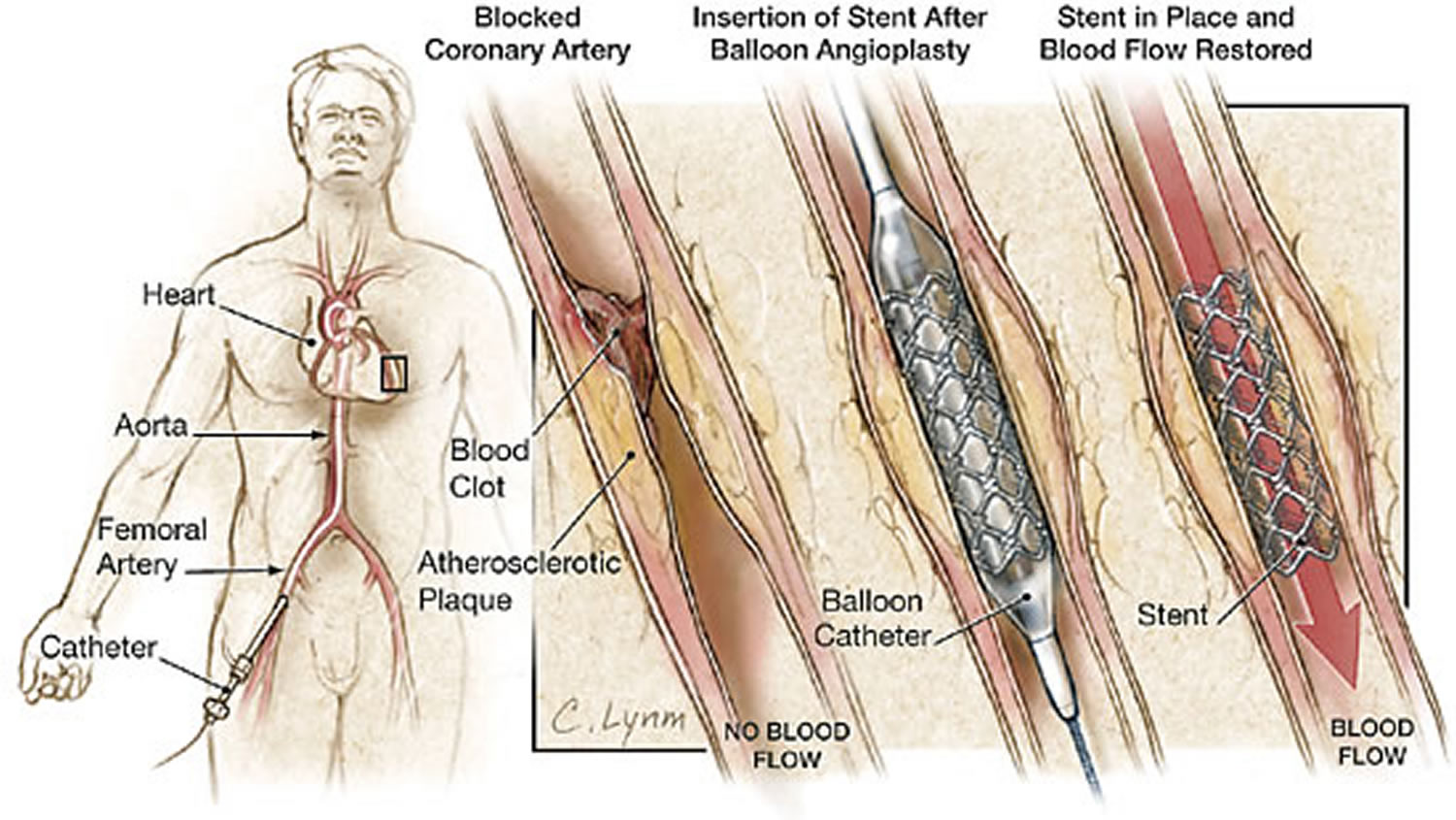
Figure 6. Coronary avenue bypass grafting
Variant (Prinzmetal's) Angina
Variant angina or Prinzmetal's angina is rare, representing well-nigh two out of 100 cases of angina, and usually occurs in younger patients than those who have other kinds of angina xviii) . A spasm in a coronary artery causes this type of angina. Variant angina almost always occurs while you're at rest, and the hurting tin can be severe. It commonly happens between midnight and early morning time. These attacks can exist very painful. Medicine can salve this type of angina.
Causes of Variant (Prinzmetal) Angina:
The pain from variant angina is caused by a spasm in the coronary arteries (which supply blood to the heart muscle).
The coronary arteries tin can spasm as a result of:
- Exposure to cold weather
- Stress
- Medicines that tighten or narrow blood vessels
- Smoking
- Cocaine use
Symptoms of Variant (Prinzmetal) Angina:
The hurting or discomfort:
- Usually occurs while resting and during the dark or early morning hours
- Are ordinarily severe
- Tin exist relieved by taking medication
Treatment of Variant Angina (Prinzmetal'south Angina)
Medicines tin can help control the spasms. Drugs such every bit calcium antagonists and nitrates are the mainstays of treatment.
The spasms tend to come in cycles – actualization for a time, then going away. Afterwards six to 12 months of handling, doctors may gradually reduce the medication.
Prinzmetal'south angina is a chronic status that will need to be followed by your healthcare provider even though the prognosis is mostly skillful.
Microvascular Angina
Microvascular angina or breast pain, tin be more severe and terminal longer than other types of angina. Medicine may not relieve this type of angina.
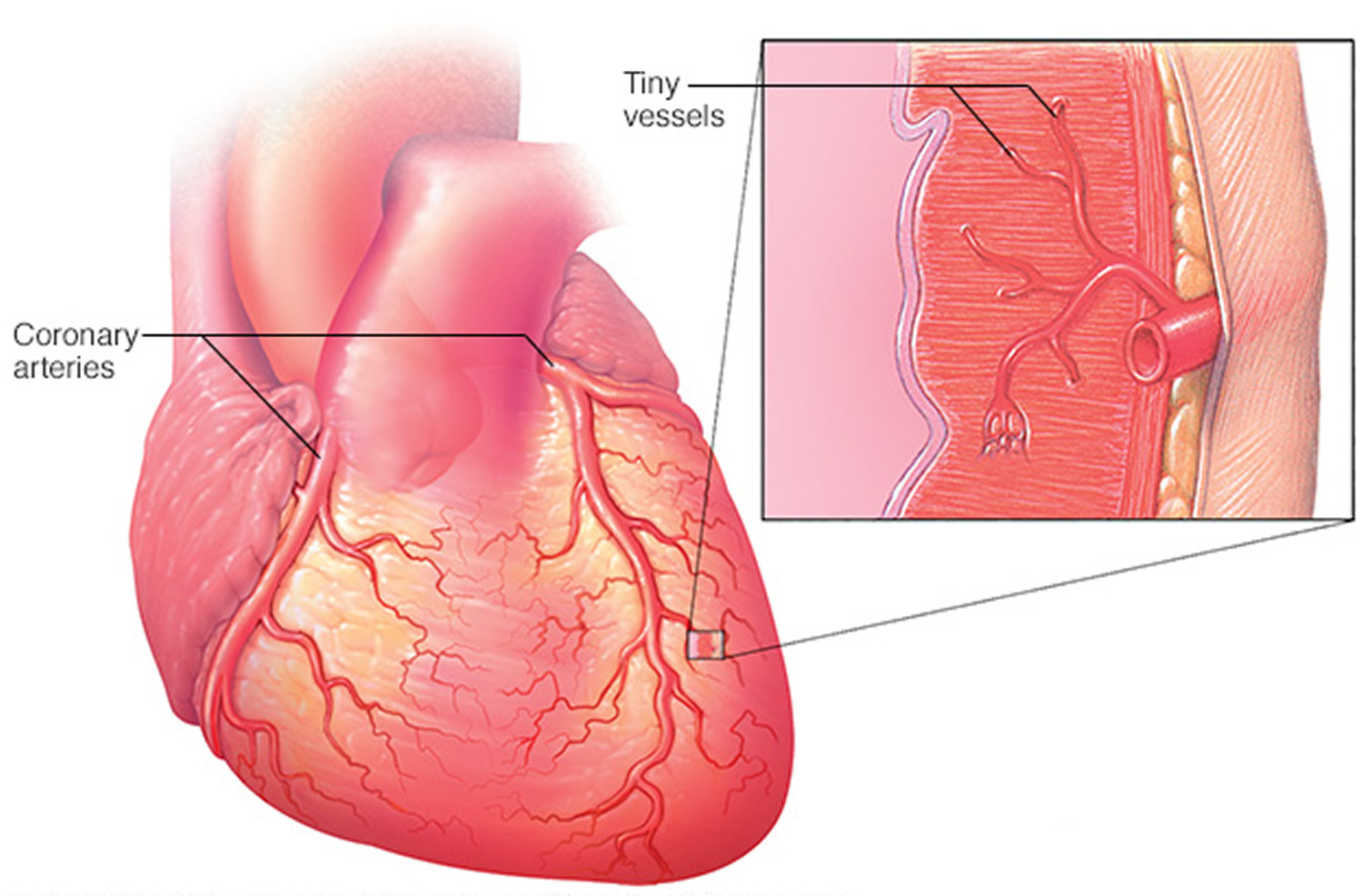
This type of angina may be a symptom of coronary microvascular disease. Coronary microvascular disease is heart disease that affects the heart'south smallest coronary artery blood vessels.
Causes of microvascular angina:
Spasms within the walls of these very small-scale arterial blood vessels causes reduced blood flow to the center musculus leading to a type of breast pain referred to as microvascular angina.
Symptoms of microvascular angina:
Angina that occurs in coronary microvascular disease may differ from the typical angina that occurs in heart disease in that the chest pain usually lasts longer than x minutes, and it tin final longer than 30 minutes. If you have been diagnosed with microvascular disease, follow the directions from your healthcare provider regarding how to treat your symptoms and when to seek emergency assist.
The pain or discomfort:
- May be more severe and last longer than other types of angina pain
- May occur with shortness of breath, sleep problems, fatigue, and lack of energy
- Often is first noticed during routine daily activities and times of mental stress
Figure seven. Microvascular coronary artery disease
Coronary Microvascular Disease
Coronary microvascular disease (sometimes called pocket-sized artery affliction or small vessel disease) is heart illness that affects the walls and inner lining of tiny coronary artery blood vessels that branch off from the larger coronary arteries 19) . Coronary heart disease, besides called coronary avenue disease, involves plaque germination that tin can block blood menstruum. In coronary microvascular disease, the heart's tiny coronary artery blood vessels may not have plaque, but harm to the inner walls of the blood vessels that can atomic number 82 to spasms and decrease blood menstruum to the heart muscle. According to the National Heart, Lung, and Blood Constitute's Wise report (Women's Ischemia Syndrome Evaluation), every bit many as three one thousand thousand U.Due south. women with coronary heart illness, cholesterol plaque may not build up into major blockages, but instead spreads evenly throughout the artery wall xx) . Every bit a result, diagnostic coronary angiography reveals that these women have "articulate" arteries no blockages incorrectly indicating low risk. Despite this, many of these women accept a loftier chance for centre attack, according to newly published research from the National Institutes of Health 21) .
In women with this condition, called coronary microvascular syndrome, plaque accumulates in very small arteries of the heart, causing narrowing, reduced oxygen period to the heart, and pain that tin can exist similar to that of people with blocked arteries, only the plaque does not show up when physicians use standard tests. As a result, many women go undiagnosed. Enquiry is ongoing to learn more than well-nigh the part of hormones in centre illness and to find ameliorate ways to diagnose coronary microvascular disease.
Women more frequently develop coronary microvascular illness and it occurs particularly in younger women; notwithstanding, men and women who have coronary microvascular disease ofttimes have diabetes, high claret pressureor a family history of cardiomyopathy.
Diagnosing coronary microvascular disease has been a challenge for doctors 22) . Standard tests used to diagnose coronary heart illness are not designed to detect coronary microvascular disease, and then more research is needed to find the best diagnostic tests and treatments for the affliction.
Other Names for Coronary Microvascular Disease
- Cardiac syndrome X
- Nonobstructive coronary heart disease
What Causes Coronary Microvascular Disease ?
The same risk factors that cause atherosclerosis may cause coronary microvascular illness. Atherosclerosis is a disease in which plaque builds upward inside the arteries.
Risk factors for atherosclerosis include:
- Unhealthy claret cholesterol levels
- High blood pressure
- Smoking
- Diabetes
- Overweight and obesity
- Inactivity
- Unhealthy nutrition
- Older age
- Family unit history of heart disease
Understand Your Chance for Coronary Microvascular Disease ?
Women may be at hazard for coronary microvascular affliction if they have lower than normal estrogen levels at whatsoever point in their adult lives. Low estrogen levels before menopause tin can raise younger women'southward take a chance for coronary microvascular disease and tin can exist caused by stress and also a functioning problem with the ovaries.
Women who take high blood pressure earlier menopause, particularly high systolic blood pressure level, are at increased risk for coronary microvascular affliction. After menopause, women tend to take more than of the traditional risk factors for atherosclerosis, which also puts them at higher take a chance for coronary microvascular affliction.
Women who accept eye disease are more than probable to have a worse outcome, such as a heart attack, if they also have anemia considering anemia is thought to tedious the growth of cells needed to repair damaged blood vessels.
What Are the Signs and Symptoms of Coronary Microvascular Affliction ?
Women with coronary microvascular disease often have chest pain called angina, as well called microvascular angina usually lasting longer than ten minutes, and information technology tin last longer than thirty minutes.
Other signs and symptoms of coronary microvascular disease are:
- shortness of jiff
- slumber bug
- fatigue
- lack of energy
People that experience coronary microvascular disease symptoms often commencement notice them during their routine daily activities and times of mental stress but less often during physical activity or exertion. This differs from heart disease, in which symptoms frequently kickoff appear while a person is beingness physically active. If yous have coronary microvascular affliction, learn the warning signs of a heart attack and the warning signs of a heart attack in women.
Diagnosis of Coronary Microvascular Disease
Your healthcare provider volition diagnose coronary microvascular disease based on your medical history, a concrete exam, and test results. They will likewise bank check to encounter whether you have any risk factors for center affliction. For case, your doc may measure your weight and height to cheque for overweight or obesity. He or she besides may recommend tests for high cholesterol, metabolic syndrome, and diabetes.
Diagnostic Tests for Coronary Microvascular Disease
The run a risk factors for coronary microvascular illness and traditional centre illness ofttimes are the same. Thus, your medico may recommend tests for heart disease, such equally:
- Coronary angiography
- Stress examination
- Magnetic Resonance Imaging (MRI)
Unfortunately, standard tests for coronary heart disease aren't designed to detect coronary microvascular illness. These tests look for blockages in the large coronary arteries. Coronary microvascular affliction affects the tiny coronary arteries. If test results show that you don't have heart disease, your doctor might however diagnose you with coronary microvascular disease. This could happen if signs are present that non enough oxygen is reaching your middle'southward tiny arteries.
Coronary microvascular disease symptoms frequently outset occur during routine daily tasks. Because of this, your doc may ask yous to fill out a questionnaire chosen the Duke Activity Condition Alphabetize (DASI). The will ask you how well you're able to exercise daily activities, such as shopping, cooking, and going to piece of work.
The Duke Activity Status Alphabetize (DASI) results will help your doctor decide which kind of stress test you should accept. The results also give your doctor information about how well blood is flowing through your coronary arteries.
Duke Activity Status Index (DASI)
The Duke Activity Condition Alphabetize is a self-administered questionnaire that measures a patient's functional capacity 23) . Information technology can be used to become a rough estimate of a patient's peak oxygen uptake.
- Can you take care of yourself (eating, dressing, bathing or using the toilet)?
- Can yous walk indoors, such as around your house?
- Can you lot walk a cake or ii on level basis?
- Can you climb a flight of stairs or walk up a hill?
- Tin can you lot run a short distance?
- Can you do light piece of work around the business firm, such as dusting or washing dishes?
- Can you exercise moderate work around the house, such as vacuuming, sweeping floors or conveying in groceries?
- Can you do heavy piece of work around the business firm, such as scrubbing floors or lifting and moving heavy furniture?
- Tin can you do yard work, such equally raking leaves, weeding or pushing a power mower?
- Tin can you have sexual relations?
- Tin you participate in moderate recreational activities, such every bit golf game, bowling, dancing, doubles tennis or throwing a baseball or football?
- Can you participate in strenuous sports, such as swimming, singles tennis, football, basketball or skiing?
Duke Activity Condition Alphabetize (DASI) = sum of "Aye" replies ___________
VO2peak = (0.43 x DASI) + 9.half dozen
VO2peak = ___________ ml/kg/min ÷ three.5 ml/kg/min = __________ METS
———————————————————————————————————————————————————————————-
Your doctor likewise may recommend blood tests, including a test for anemia. Anemia is idea to slow the growth of cells needed to repair damaged blood vessels.
Research is ongoing for ameliorate means to observe and diagnose coronary microvascular disease. Currently, researchers accept not agreed on the best mode to diagnose the disease.
Treatment of Coronary Microvascular Affliction
Relieving hurting is one of the main goals of treating coronary microvascular disease. Treatments also are used to control risk factors and other symptoms.
Treatments may include medicines such as:
- Cholesterol medication to meliorate cholesterol levels
- Antithrombotic medications to lower blood force per unit area and decrease the eye's workload
- Medication to aid prevent claret clots or control inflammation
- Nitroglycerin to relax claret vessels, meliorate blood flow to the heart muscle, and treat chest pain
Prevention of Coronary Microvascular Disease
No specific studies have been done on how to forbid coronary microvascular disease. Researchers don't all the same known how or in what manner preventing coronary microvascular affliction differs from preventing center disease. Lifestyle changes and ongoing care can help you lower your take a chance for heart disease.
- Lifestyle Changes – If lifestyle changes aren't enough, your doctor may prescribe medicines to control your chance factors. Take all of your medicines every bit your medico advises.
- Know your torso mass index (BMI)
- Know your family history of middle affliction
Angina in Women
Heart disease in men is more oft due to blockages in their coronary arteries, referred to equally obstructive coronary artery disease (coronary heart affliction). Women more frequently develop heart disease within the very small arteries that branch out from the coronary arteries. This is referred to as microvascular disease and occurs specially in younger women. Up to fifty percent of women with anginal symptoms who undergo cardiac catheterization don't take the obstructive blazon of coronary avenue affliction (coronary heart disease).
Cardiovascular disease is the No. one killer of women in the United States, affecting one out of every three in the United States. Nearly half of African-American women accept cardiovascular disease.
Recognizing the signs and seeking treatment is the offset stride. Agreement your chance factors, such as a family history, is also important to staying in tune with changes in your health.
What Is Pulmonary Embolism ?
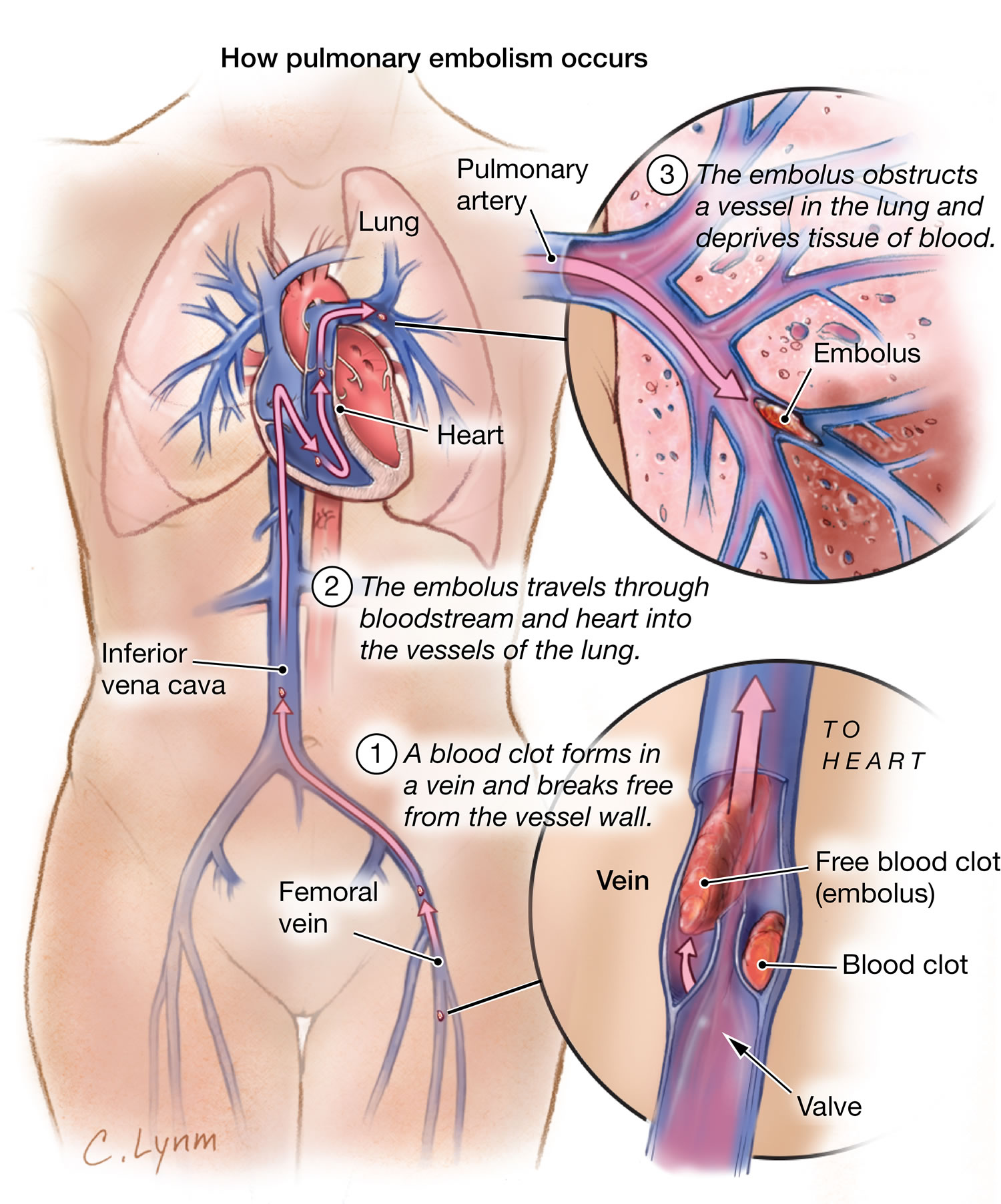
Pulmonary embolism is a sudden blockage in a lung avenue. The blockage commonly is caused by a blood clot that travels to the lung from a vein in the leg 24) .
A clot that forms in one part of the torso and travels in the bloodstream to some other part of the trunk is called an embolus.
Pulmonary embolism nigh oft is a complexity of a condition called deep vein thrombosis (DVT). In deep vein thrombosis (DVT), blood clots form in the deep veins of the body—virtually often in the legs. These clots can suspension gratis, travel through the bloodstream to the lungs, and block an avenue.
Deep vein clots are not like clots in veins shut to the pare'due south surface. Those clots remain in place and do not crusade pulmonary embolism.
Blood clots can form in the deep veins of the legs if blood flow is restricted and slows down. This can happen if yous don't motion around for long periods, such as:
- After some types of surgery
- During a long trip in a car or airplane
- If yous must stay in bed for an extended fourth dimension
Blood clots are more probable to develop in veins damaged from surgery or injured in other means. Rarely, an air bubble, part of a tumor, or other tissue travels to the lungs and causes pulmonary embolism. As well, if a large bone in the body (such as the thigh bone) breaks, fat from the bone marrow tin travel through the blood. If the fat reaches the lungs, it can cause pulmonary embolism.
Pulmonary embolism is a serious condition that can:
- Damage part of your lung because of a lack of blood menses to your lung tissue. This damage may pb to pulmonary hypertension (increased pressure level in the pulmonary arteries).
- Cause low oxygen levels in your blood.
- Impairment other organs in your body because of a lack of oxygen.
If a blood jell is large, or if there are many clots, pulmonary embolism tin can cause death.
Figure 8. Pulmonary embolism
Outlook for Pulmonary embolism
The exact number of people affected past deep vein thrombosis and pulmonary embolism isn't known. Estimates suggest these atmospheric condition affect 300,000 to 600,000 people in the United States each twelvemonth.
If left untreated, virtually 30 percent of patients who take pulmonary embolism will die 25) . Most of those who die do so within the first few hours of the event.
The expert news is that a prompt diagnosis and proper handling can save lives and assist prevent the complications of pulmonary embolism.
What is Aortic Dissection
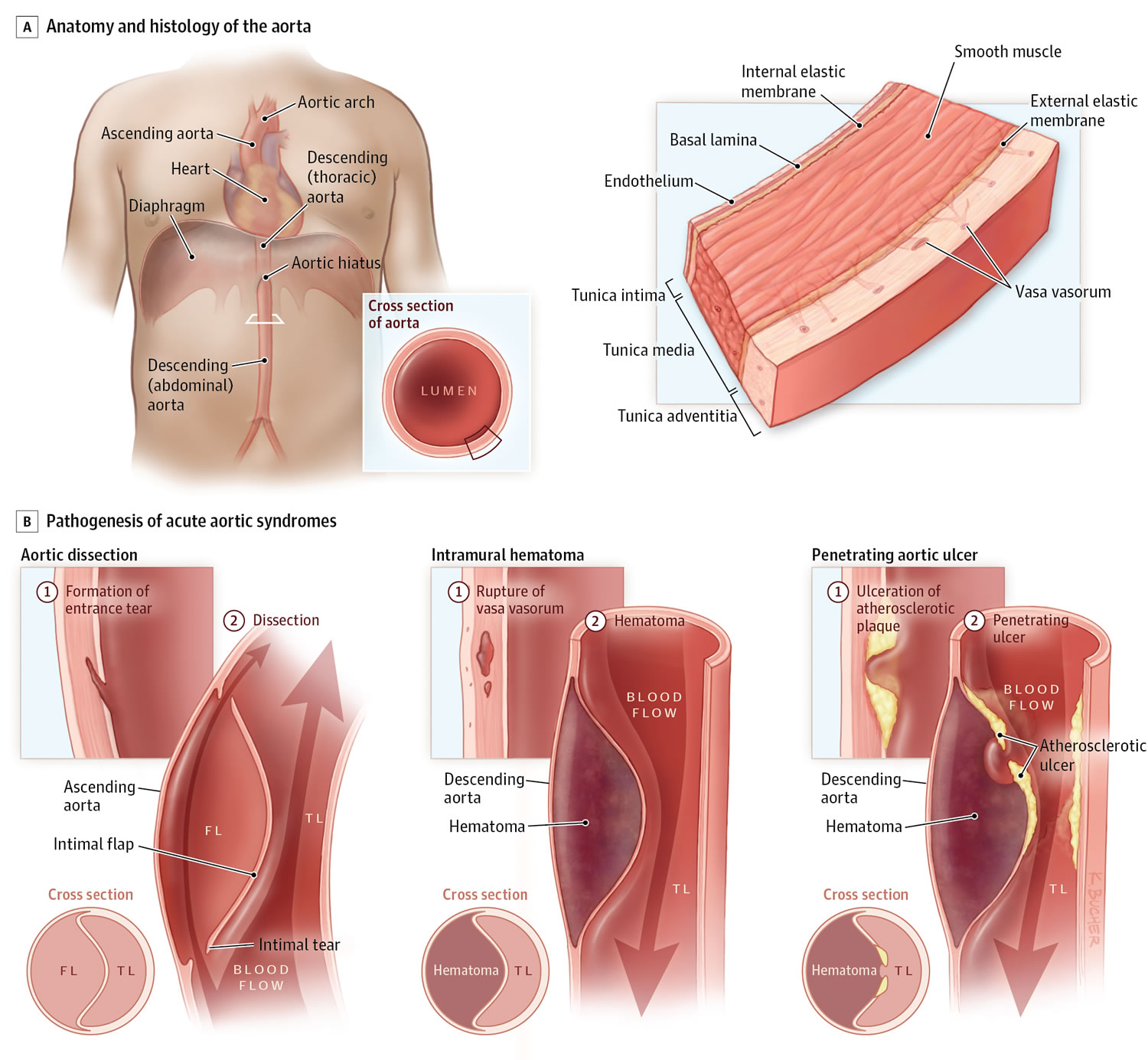
Aortic dissection is a serious condition in which there is a tear in the wall of the major artery carrying blood out of the heart (aorta). As the tear extends along the wall of the aorta, blood can flow in between the layers of the blood vessel wall (dissection). This tin pb to aortic rupture or decreased claret menses (ischemia) to organs.
Aortic dissection occurs in about 2 out of every 10,000 people. Information technology tin touch anyone, but is nigh often seen in men ages forty to lxx.
Causes of Aortic dissection
When it leaves the heart, the aorta outset moves upward through the chest towards the head (the ascending aorta). Information technology then bends or arches, and finally moves down through the breast and abdomen (the descending aorta).
Aortic dissection most oftentimes happens because of a tear or damage to the inner wall of the aorta. This very often occurs in the chest (thoracic) office of the artery, but information technology may also occur in the intestinal aorta.
When a tear occurs, it creates two channels:
- One in which blood continues to travel
- Some other where blood stays still
If the aqueduct with not-traveling blood gets bigger, it can push on other branches of the aorta. This can narrow the other branches and reduce blood menstruation through them.
An aortic dissection may also cause abnormal widening or ballooning of the aorta (aneurysm).
The exact cause is unknown, but more than common risks include:
- Crumbling
- Atherosclerosis
- Blunt trauma to the chest, such as hitting the steering bike of a car during an accident
- High claret pressure
Other run a risk factors and weather linked to aortic dissection include:
- Bicuspid aortic valve
- Coarctation (narrowing) of the aorta
- Connective tissue disorders (such as Marfan syndrome and Ehlers-Danlos syndrome) and rare genetic disorders
- Middle surgery or procedures
- Pregnancy
- Swelling of the claret vessels due to atmospheric condition such as arteritis and syphilis.
Figure 9. Aortic autopsy
Symptoms of Aortic Autopsy
In most cases, the symptoms begin suddenly, and include severe chest pain. The pain may feel like a centre attack.
- Hurting tin be described equally sharp, stabbing, violent, or ripping.
- It is felt beneath the chest bone, and then moves under the shoulder blades or to the back.
- Pain can move to the shoulder, neck, arm, jaw, abdomen, or hips.
- The hurting changes position, ofttimes moving to the arms and legs equally the aortic dissection gets worse.
Symptoms are acquired by a subtract of blood flowing to the balance of the body, and can include:
- Anxiety and a feeling of doom
- Fainting or dizziness
- Heavy sweating (clammy skin)
- Nausea and vomiting
- Pale peel (pallor)
- Rapid, weak pulse
- Shortness of jiff and problem breathing when lying flat (orthopnea)
Other symptoms may include:
- Pain in the abdomen
- Stroke symptoms
- Swallowing difficulties from pressure level on the esophagus
Exams and Tests for Aortic Autopsy
The health care provider will take your family unit history and listen to your heart, lungs, and belly with a stethoscope. The exam may observe:
- A "blowing" murmur over the aorta, heart murmur, or other aberrant sound
- A difference in blood pressure between the right and left arms, or betwixt the artillery and legs
- Low blood pressure
- Signs resembling a heart assail
- Signs of stupor, just with normal blood pressure
Aortic dissection or aortic aneurysm may be seen on:
- Aortic angiography
- Chest x-ray
- Chest MRI
- CT browse of breast with dye
- Doppler ultrasonography (occasionally performed)
- Echocardiogram
- Transesophageal echocardiogram (TEE)
Blood piece of work to rule out a heart set on is needed.
Handling of Aortic Dissection
Aortic dissection is a life-threatening condition and needs to exist treated right away.
- Dissections that occur in the function of the aorta that is leaving the heart (ascending) are treated with surgery.
- Dissections that occur in other parts of the aorta (descending) may be managed with surgery or medicines.
2 techniques may exist used for surgery:
- Standard, open surgery. This requires a surgical incision that is fabricated in the chest or abdomen.
- Endovascular aortic repair. This surgery is washed without any major surgical incisions.
Drugs that lower claret pressure may be prescribed. These drugs may exist given through a vein (intravenously). Beta-blockers are the first drugs of choice. Strong pain relievers are very oftentimes needed.
If the aortic valve is damaged, valve replacement is needed. If the heart arteries are involved, a coronary bypass is also performed.
Outlook (Prognosis) for Aortic Autopsy
Aortic dissection is life threatening. The condition can exist managed with surgery if it is washed before the aorta ruptures. Less than one half of people with a ruptured aorta survive.
Those who survive volition need lifelong, aggressive treatment of high blood pressure level. They volition demand to be followed upward with CT scans every few months to monitor the aorta.
Possible Complications of Aortic Dissection
Aortic autopsy may decrease or stop the claret flow to many unlike parts of the torso. This may upshot in brusque-term or long-term problems, or harm to the:
- Brain
- Centre
- Intestines or bowels
- Kidneys
- Legs
What is Aortic Valve Stenosis
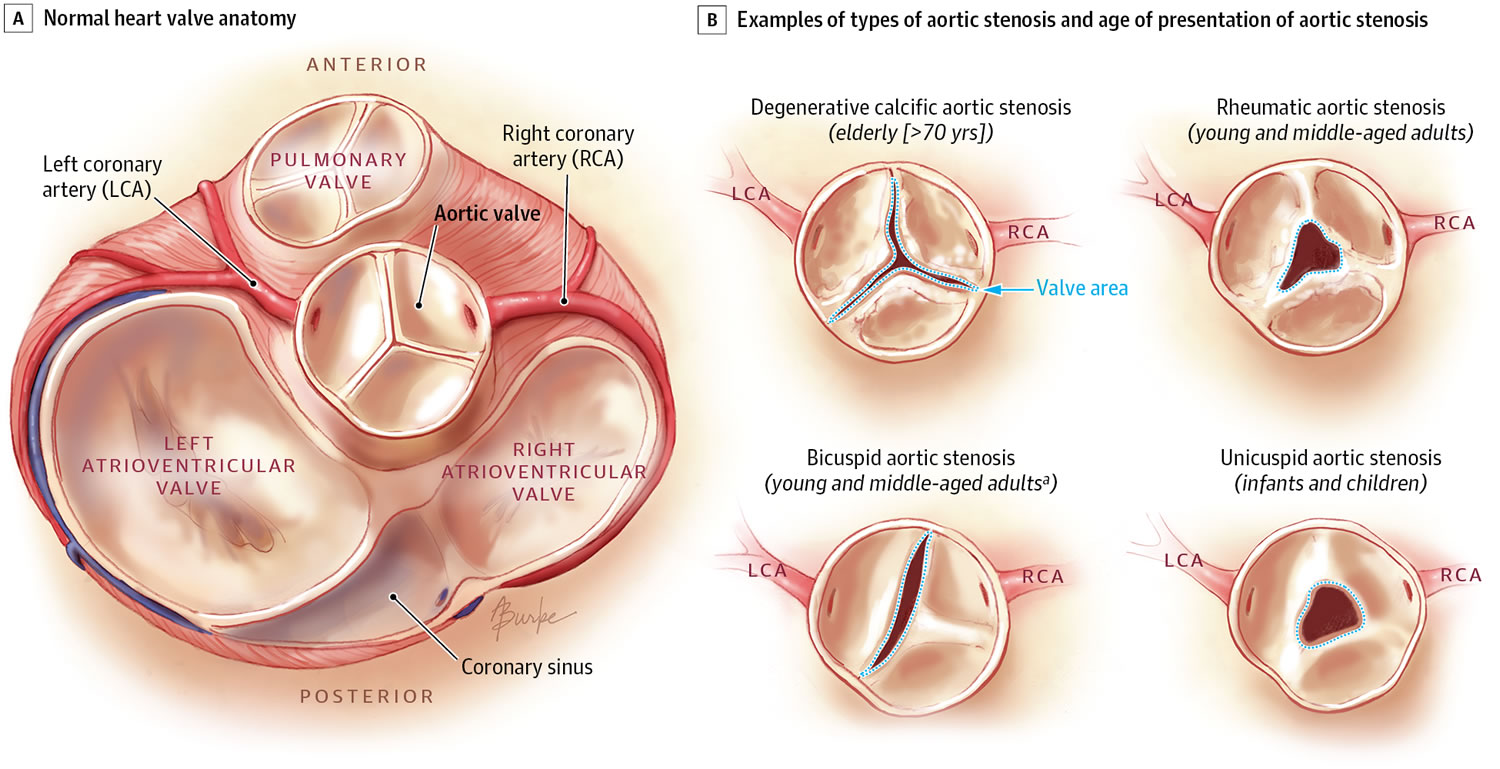
The aorta is the main avenue that carries claret out of the middle to the rest of the body. Blood flows out of the heart and into the aorta through the aortic valve. A normal aortic valve has three leaflets or cusps (tricuspid). About 1 per centum of the population is built-in with a valve that only has two leaflets (bicuspid) and narrows or leaks over time. In aortic stenosis, the aortic valve does not open fully. This decreases blood catamenia from the heart 26) .
Some infants are born with severely narrowed aortic valves need early treatment. However, most bicuspid aortic valves work normally for a long time — sometimes a lifetime. In other patients, the valve can become thick and narrowed/obstructed (stenotic) or curled at the edges and leaky (regurgitant or insufficient). When the valve is obstructed the left ventricle pumps at a college pressure than normal to button the blood through the narrow opening. In response, the heart muscle gets thicker. This can lead to chest hurting. When the valve primarily leaks, the ventricle has to pump more blood and the ventricle enlarges.
As the pressure continues to rising, blood may back up into the lungs. Astringent aortic stenosis can limit the corporeality of blood that reaches the brain and the rest of the body.
With balmy obstruction, patients usually have no symptoms. The problem is detected by the presence of a clicking audio in the heart and a murmur. When the valve opening narrows to most 1-fourth its original size, symptoms are common. The near common symptom of an obstructed or leaky aortic valve is shortness of breath with exertion. This ordinarily develops gradually over time, and some patients volition just feel "out of shape." Chest pain, lightheadedness or fainting may also occur. Recurrent fevers may point the valve is infected.
Figure 10. Aortic Valve Stenosis
Causes of Aortic Stenosis
Aortic stenosis may exist present from birth (congenital), only well-nigh oft it develops afterward in life. Children with aortic stenosis may have other conditions present from birth.
Aortic stenosis mainly occurs due to the buildup of calcium deposits that narrow the valve. This is chosen calcific aortic stenosis. The problem by and large affects older people.
Calcium buildup of the valve happens sooner in people who are born with abnormal aortic or bicuspid valves. In rare cases, calcium buildup can develop more quickly when a person has received chest radiations (such as for cancer treatment).
Some other cause is rheumatic fever. This condition can develop after strep throat or scarlet fever. Valve problems do not develop for 5 to 10 years or longer after rheumatic fever occurs. Rheumatic fever is condign rarer in the U.s..
Aortic stenosis occurs in about two% of people over 65 years of age. It occurs more than often in men than in women.
Symptoms of Aortic Stenosis
Well-nigh people with aortic stenosis practice non develop symptoms until the disease is advanced. The diagnosis may take been fabricated when the wellness care provider heard a heart murmur and performed tests.
Symptoms of aortic stenosis include:
- Chest discomfort: The chest pain may become worse with activity and reach into the arm, neck, or jaw. The chest may also feel tight or squeezed.
- Cough, possibly bloody.
- Breathing issues when exercising.
- Becoming hands tired.
- Feeling the heartbeat (palpitations).
- Fainting, weakness, or dizziness with activity.
In infants and children, symptoms include:
- Becoming easily tired with exertion (in mild cases)
- Failure to gain weight
- Poor feeding
- Serious breathing problems that develop inside days or weeks of birth (in astringent cases)
Children with mild or moderate aortic stenosis may become worse as they become older. They are also at chance for a heart infection called bacterial endocarditis.
Exams and Tests forAortic Stenosis
A heart murmur, click, or other abnormal sound is almost always heard through a stethoscope. The provider may be able to feel a vibration or movement when placing a hand over the heart. There may be a faint pulse or changes in the quality of the pulse in the neck.
Blood pressure may be depression.
Aortic stenosis is most often detected and then followed using a test called a transthoracic echocardiogram (TTE).
The following tests may likewise be performed:
- ECG
- Exercise stress testing
- Left cardiac catheterization
- MRI of the heart
- Transesophageal echocardiogram (TEE)
Treatment of Aortic Stenosis
Regular checkups by a provider may be all that is needed if your symptoms are not severe. The provider should enquire about your health history, practise a concrete exam, and perform an echocardiogram.
People with astringent aortic stenosis may exist told not to play competitive sports, even if they accept no symptoms. If symptoms do occur, strenuous activity must oft be limited.
Medicines are used to treat symptoms of heart failure or abnormal center rhythms (near normally atrial fibrillation). These include diuretics (water pills), nitrates, and beta-blockers. High blood pressure should also be treated. If aortic stenosis is severe, this handling must be washed carefully and so claret pressure does non drib too far.
In the past, most people with heart valve bug were given antibiotics earlier dental work or a procedure such every bit colonoscopy. The antibiotics were given to forbid an infection of the damaged heart. However, antibiotics are now used much less often earlier dental work and other procedures. Check with your health intendance provider to detect out whether you need antibiotics.
People with this and other centre conditions should stop smoking and be tested for high cholesterol.
Surgery to repair or replace the valve is often done for adults or children who develop symptoms. Even if symptoms are non very bad, the doctor may recommend surgery based on test results.
A less invasive procedure called balloon valvuloplasty may be done instead of or earlier surgery.
A balloon is placed into an artery in the groin, threaded to the middle, placed across the valve, and inflated. However, narrowing often occurs again afterwards this procedure.
A newer process done at the aforementioned time equally valvuloplasty can implant an bogus valve. This procedure is well-nigh oft done in patients who cannot have surgery, simply it is becoming more common.
Some children may need aortic valve repair or replacement. Children with mild aortic stenosis may be able to have role in virtually activities.
Outlook (Prognosis) of Aortic Stenosis
The event varies. The disorder may be balmy and not produce symptoms. Over time, the aortic valve may get narrower. This may result in more severe heart bug such equally:
- Atrial fibrillation and atrial flutter
- Claret clots to the brain (stroke), intestines, kidneys, or other areas
- Fainting spells (syncope)
- Heart failure
- High blood pressure in the arteries of the lungs (pulmonary hypertension)
The results of aortic valve replacement are often excellent. To go the best treatment, become to a eye that regularly performs this type of surgery.
Ongoing Care for Aortic Stenosis
Medical
Everyone with an aortic valve defect needs routine follow-up, whether before or later surgery. Progression occurs over time. Even with the best surgery, the patient is never "cured." The severity of your valve problem will dictate how often you lot'll need to visit the doctor and how oftentimes echocardiograms are needed. Medicines might exist useful to lower blood pressure or maintain the health of the left ventricle. Yous should also consult a cardiologist experienced in caring for adults with congenital heart disease if you are undergoing whatsoever type of non-heart surgery or invasive process.
Activity Restrictions
If y'all accept a severely obstructed valve, vigorous exercise is not a skillful thought (for more than information see the Concrete Activity and Exercise department.) Your cardiologist may tell you to limit your activity if this is the instance. Ask your cardiologist nigh your exercise limits.
Endocarditis Prevention
People with even mildly aberrant aortic valves are at risk for bacterial endocarditis. That's why information technology'south important for you to keep your oral fissure clean and healthy with regular dental cheque ups. Getting antibiotics earlier dental procedures isn't proven to be beneficial then isn't universally recommended any more. Simply if you take a prosthetic valve, you'll need to take antibiotics earlier dental work. Run into the section on Endocarditis for more information.
Bug You lot May Have
About patients feel well. Aortic stenosis (obstruction) and insufficiency (leak) normally cause symptoms but when these defects are severe. Symptoms include shortness of breath, exercise intolerance, dizziness, chest pain or occasionally abnormal centre rhythms. Patients may likewise develop an enlarged aorta over time, which may eventually require surgery. In that location are ordinarily no symptoms associated with this, which tin can just be detected with imaging.
Pregnancy
The risk from pregnancy depends on how severely the valve is obstructed or how much it's leaking.
If yous have balmy or moderate stenosis and your left heart muscle (ventricle) is operation normally, you lot can accept a safe pregnancy, only you need medical supervision throughout the pregnancy. Sometimes balloon valvuloplasty tin exist done to save symptoms if they occur during pregnancy but only when symptoms tin't be controlled by medication and bed rest.
If your stenosis is severe and y'all have symptoms, avoid conception until you've had your centre valve repaired or replaced. If you're considering pregnancy and you have aortic valve stenosis, you should meet with a multidisciplinary medical team that tin can give you more information almost the risk of pregnancy to yous and your baby.
Pregnancy in aortic regurgitation is better tolerated, but if the regurgitation has weakened the heart musculus and signs of heart failure are present before pregnancy, the chance posed past pregnancy is higher.
In patients who have had their eye valve replaced with a metal (mechanical) heart valve, they may be taking warfarin (Coumadin) which can crusade hazard to the fetus and culling means of claret thinning may exist required. In aortic insufficiency, women may be taking medicines such as ACE inhibitors such every bit lisinopril (Zestril) or enalapril (Vasotec). These drugs are dangerous to the developing fetus (see the department on Pregnancy) and need to exist changed before formulation.
It'due south best to talk with your doctor before you program to go pregnant.
Will you need more surgery ?
If you already had an functioning on your aortic valve, chances are high that you may need another. This may exist to replace a valve or an enlarging aorta. No surgical set is ever perfect, and then regular follow-up with a doctor who is informed nigh this particular trouble is recommended.
What is Hypertrophic cardiomyopathy
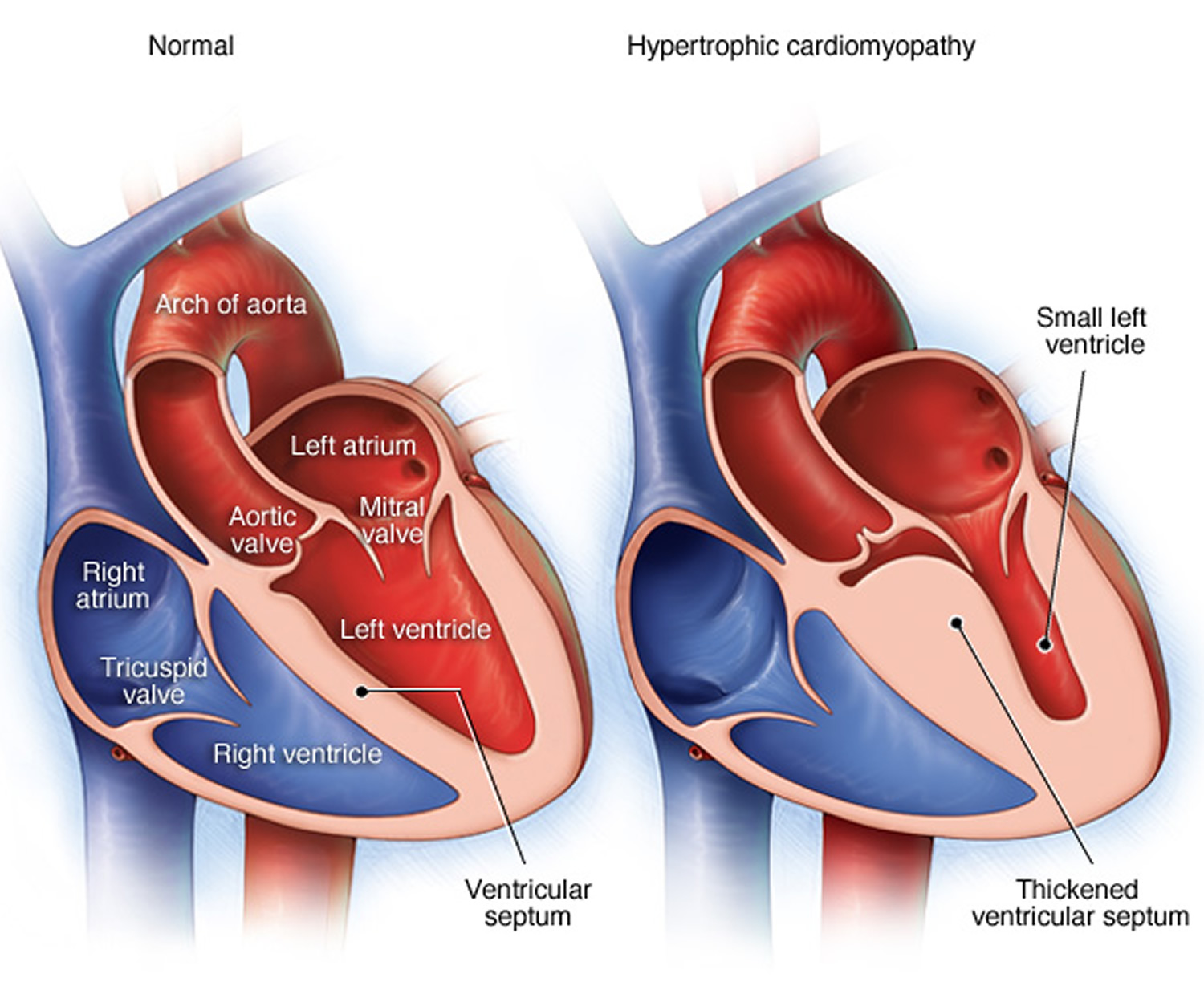
Hypertrophic cardiomyopathy is a status in which the eye muscle becomes thick 27) . Often, but one part of the heart is thicker than the other parts.
The thickening tin brand it harder for blood to leave the middle, forcing the heart to piece of work harder to pump blood. It as well can make information technology harder for the centre to relax and fill with blood.
Effigy 11. Hypertrophic cardiomyopathy
Causes of Hypertrophic cardiomyopathy
Hypertrophic cardiomyopathy is almost oftentimes passed downwards through families (inherited). It is idea to outcome from defects in the genes that command heart muscle growth.
Younger people are probable to have a more severe course of hypertrophic cardiomyopathy. However, the condition is seen in people of all ages.
Symptoms of Hypertrophic cardiomyopathy
Some people with the condition may have no symptoms. They may first notice out they have the problem during a routine medical exam.
In many immature adults, the start symptom of hypertrophic cardiomyopathy is sudden collapse and possible death. This tin can exist caused by highly abnormal center rhythms (arrhythmias). It may as well exist due to a blockage that prevents the outflow of blood from the heart to the rest of the trunk.
Common symptoms include:
- Breast pain
- Dizziness
- Fainting, especially during exercise
- Fatigue
- Lightheadedness, especially with or after activity or exercise
- Awareness of feeling the eye shell fast or irregularly (palpitations)
- Shortness of breath with activeness or after lying down (or being asleep for a while)
Exams and Tests for Hypertrophic cardiomyopathy
The health care provider will perform a physical test and listen to the heart and lungs with a stethoscope. Signs may include:
- Aberrant eye sounds or a heart murmur. These sounds may change with unlike body positions.
- High blood force per unit area.
- The pulse in your arms and neck will also exist checked. The provider may feel an aberrant heartbeat in the chest.
Tests used to diagnose heart muscle thickness, problems with blood flow, or leaky heart valves (mitral valve regurgitation) may include:
- Echocardiography
- ECG
- 24-hour Holter monitor (centre rhythm monitor)
- Cardiac catheterization
- Chest ten-ray
- MRI of the heart
- Transesophageal echocardiogram (TEE)
Claret tests may be washed to dominion out other diseases.
Shut family members of people who have been diagnosed with hypertrophic cardiomyopathy may be screened for the condition.
Treatment for Hypertrophic cardiomyopathy
Always follow your provider's advice about practice if you lot have hypertrophic cardiomyopathy. You may be told to avoid strenuous exercise. Likewise, meet your provider for regularly scheduled checkups.
If you have symptoms, you may demand medicines such every bit beta-blockers and calcium channel blockers to help the eye contract and relax correctly. These drugs may relieve chest hurting or shortness of breath when exercising.
People with arrhythmias may need treatment, such as:
- Medicines to treat the abnormal rhythm.
- Blood thinners to reduce the risk of blood clots (if the arrhythmia is due to atrial fibrillation).
- A permanent pacemaker to command the heartbeat.
- An implanted defibrillator that recognizes life-threatening heart rhythms and sends an electrical pulse to finish them. Sometimes a defibrillator is placed, fifty-fifty if the patient has non had an arrhythmia but is at high run a risk for a mortiferous arrhythmia (for example, if the middle musculus is very sick or the patient has a relative who has died suddenly).
When blood menstruum out of the heart is severely blocked, symptoms can become severe. An operation called surgical myectomy may be done. In some cases, people may exist given an injection of booze into the arteries that feed the thickened part of the heart (alcohol septal ablation). People who have this procedure frequently prove much improvement.
You may demand surgery to repair the heart's mitral valve if information technology is leaking.
Outlook (Prognosis) for Hypertrophic cardiomyopathy
Some people with hypertrophic cardiomyopathy may non have symptoms and will have normal lifespan. Others may go worse slowly or speedily. In some cases, the condition may develop into dilated cardiomyopathy.
People with hypertrophic cardiomyopathy are at higher risk for sudden death than people without the status. Sudden expiry tin occur at a immature historic period.
There are dissimilar types of hypertrophic cardiomyopathy, which have dissimilar prognoses. The outlook may be better when the affliction occurs in older people or when in that location is a detail pattern of thickness in the middle muscle.
- Hypertrophic cardiomyopathy is a well-known cause of sudden decease in athletes. Nearly half of deaths due to this condition happen during or but subsequently some type of physical activeness.
What is Pericarditis
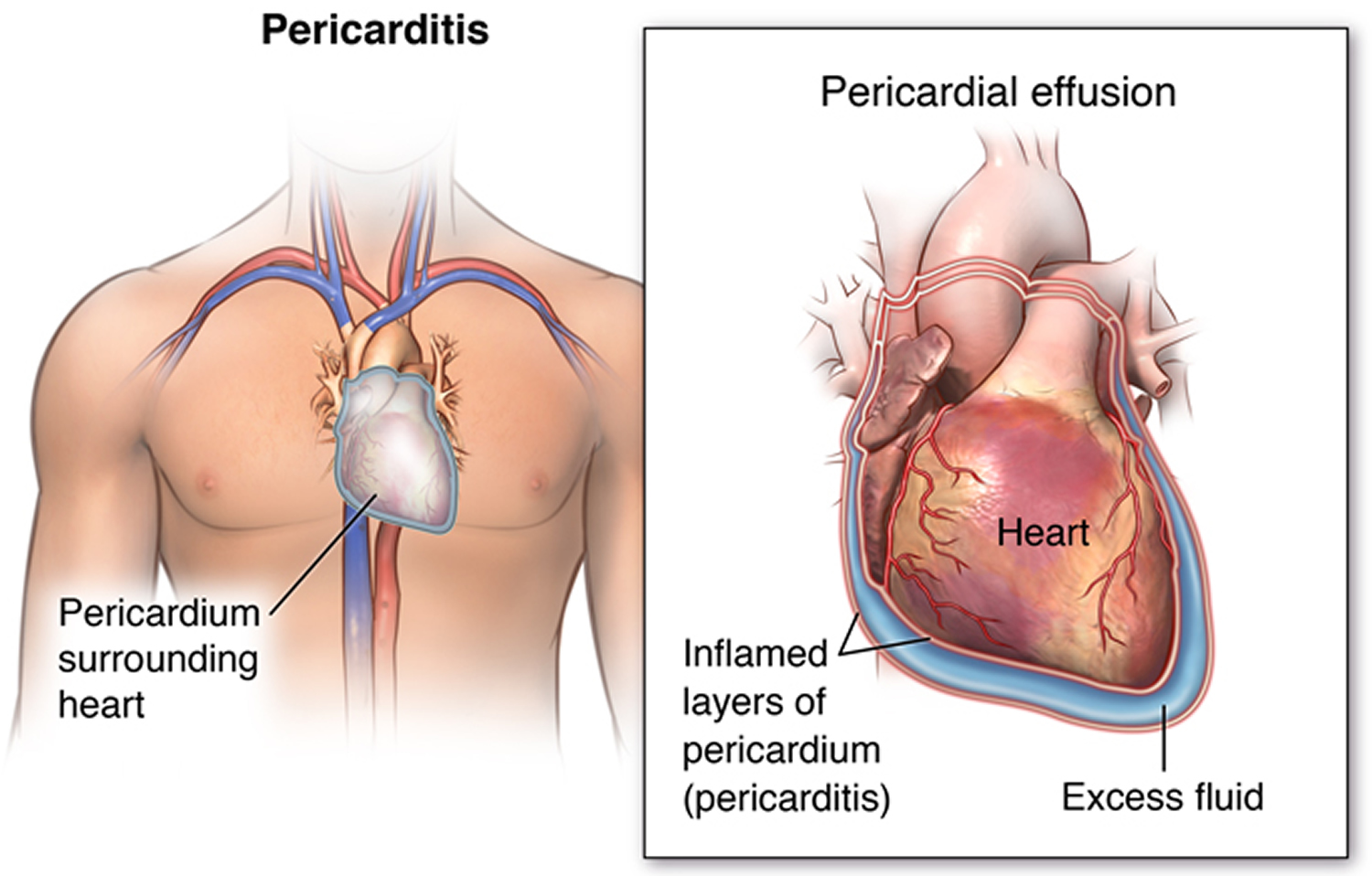
Pericarditis is a condition in which the sac-similar roofing around the heart (pericardium) becomes inflamed 28) .
Causes of Pericarditis
The cause of pericarditis is unknown or unproven in many cases. It by and large affects men ages xx to 50 years.
Pericarditis is oft the result of an infection such as:
- Viral infections that cause a breast cold or pneumonia
- Infections with leaner (less mutual)
- Some fungal infections (rare)
The condition may be seen with diseases such equally:
- Cancer (including leukemia)
- Disorders in which the immune system attacks healthy body tissue by error
- HIV infection and AIDS
- Underactive thyroid gland
- Kidney failure
- Rheumatic fever
- Tuberculosis (TB)
Other causes include:
- Heart assail
- Eye surgery or trauma to the chest, esophagus, or heart
- Sure medicines, such equally procainamide, hydralazine, phenytoin, isoniazid, and some drugs used to treat cancer or suppress the allowed system
- Swelling or inflammation of the heart muscle
- Radiations therapy to the breast.
Figure 12. Pericarditis
Symptoms of Pericarditis
Breast hurting is about always present. The pain:
- May be felt in the cervix, shoulder, back, or abdomen
- Ofttimes increases with deep breathing and lying flat, and may increase with coughing and swallowing
- Can feel sharp and stabbing
- Is often relieved past sitting up and leaning or bending forward
You may take fever, chills, or sweating if the status is caused past an infection.
Other symptoms may include:
- Ankle, feet, and leg swelling
- Anxiety
- Animate difficulty when lying downwardly
- Dry cough
- Fatigue
Exams and Tests for Pericarditis
When listening to the heart with a stethoscope, the wellness care provider can hear a sound called a pericardial rub. The center sounds may be deadened or distant. There may exist other signs of excess fluid in the pericardium (pericardial effusion).
If the disorder is severe, there may be:
- Crackles in the lungs
- Decreased breath sounds
- Other signs of fluid in the space around the lungs
The following imaging tests may exist done to cheque the heart and the tissue layer around it (pericardium):
- Breast MRI scan
- Chest x-ray
- Echocardiogram
- Electrocardiogram
- Middle MRI or middle CT browse
- Radionuclide scanning
To wait for heart muscle damage, the provider may order a troponin I exam. Other laboratory tests may include:
- Antinuclear antibiotic (ANA)
- Blood culture
- CBC
- C-reactive protein
- Erythrocyte sedimentation rate (ESR)
- HIV test
- Rheumatoid factor
- Tuberculin skin examination
Treatment for Pericarditis
The cause of pericarditis should be identified, if possible.
High doses of nonsteroidal anti-inflammatory drugs (NSAIDs) such as ibuprofen are frequently given with a medicine called colchicine. These medicines will subtract your pain and reduce the swelling or inflammation in the sac around your heart.
If the cause of pericarditis is an infection:
- Antibiotics will exist used for bacterial infections
- Antifungal medicines will be used for fungal pericarditis
Other medicines that may be used are:
- Corticosteroids such as prednisone (in some people)
- "Water pills" (diuretics) to remove excess fluid
If the buildup of fluid makes the middle function poorly, treatment may include:
- Draining the fluid from the sac. This procedure, called pericardiocentesis, may be washed using an echocardiography-guided needle.
- Cutting a small hole (window) in the pericardium (subxiphoid pericardiotomy) to allow the infected fluid to drain into the abdominal cavity
Surgery chosen pericardiectomy may be needed if the pericarditis is long-lasting, comes back after treatment, or causes scarring or tightening of the tissue around the center. The operation involves cut or removing part of the pericardium.
Outlook (Prognosis) for Pericarditis
Pericarditis tin range from mild disease that gets improve on its own, to a life-threatening condition. Fluid buildup around the middle and poor eye role can complicate the disorder.
The effect is skilful if pericarditis is treated right abroad. Nearly people recover in 2 weeks to 3 months. Notwithstanding, pericarditis may come back. This is chosen recurrent, or chronic, if symptoms or episodes continue.
Scarring and thickening of the sac-like roofing and the centre musculus may occur when the problem is severe. This is called constrictive pericarditis. It can cause long-term problems similar to those of heart failure.
What is Panic Attack
Panic disorder is a type of feet disorder in which you lot have repeated attacks of intense fearfulness that something bad volition happen 29) .
A panic attack is a sudden episode of intense fear that triggers severe concrete reactions when in that location is no real danger or credible cause xxx) . Panic attacks can be very frightening. When panic attacks occur, you lot might remember you're losing control, having a heart attack or even dying.
Many people take only one or 2 panic attacks in their lifetimes, and the problem goes away, perhaps when a stressful situation ends. Merely if you've had recurrent, unexpected panic attacks and spent long periods in constant fright of another attack, yous may accept a condition called panic disorder.
Although panic attacks themselves aren't life-threatening, they can be frightening and significantly affect your quality of life. Only treatment tin can be very constructive.
Panic attacks typically begin all of a sudden, without warning. They can strike at whatever fourth dimension — when y'all're driving a machine, at the mall, audio asleep or in the eye of a business concern meeting. Y'all may have occasional panic attacks or they may occur frequently.
Causes of Panic Disorder
The cause is unknown. Genes may play a office. Other family members may have the disorder. But panic disorder oft occurs when there is no family history.
Panic disorder is twice equally mutual in women as it is in men. Symptoms often begin before age 25, merely may occur in the mid-30s. Children tin too take panic disorder, but information technology is often not diagnosed until they are older.
A panic set on is a sudden episode of intense fear that triggers severe physical reactions when there is no existent danger or credible cause. Panic attacks can be very frightening. When panic attacks occur, you might think you're losing command, having a heart attack or fifty-fifty dying.
Many people have simply ane or 2 panic attacks in their lifetimes, and the problem goes abroad, perhaps when a stressful situation ends. But if you lot've had recurrent, unexpected panic attacks and spent long periods in constant fright of another attack, you may have a condition called panic disorder.
Although panic attacks themselves aren't life-threatening, they can be frightening and significantly affect your quality of life. Only treatment can be very constructive.
Panic attacks typically begin suddenly, without warning. They can strike at whatsoever time — when you're driving a car, at the mall, sound asleep or in the eye of a business organisation coming together. You may take occasional panic attacks or they may occur ofttimes.
Panic attacks take many variations, but symptoms commonly peak inside minutes. You may feel fatigued and worn out afterwards a panic attack subsides.
Factors that may increment the risk of developing panic attacks or panic disorder include:
- Family history of panic attacks or panic disorder
- Major life stress, such as the death or serious disease of a loved one
- A traumatic event, such as sexual set on or a serious accident
- Major changes in your life, such every bit a divorce or the add-on of a baby
- Smoking or excessive caffeine intake
- History of childhood physical or sexual abuse
Left untreated, panic attacks and panic disorder tin touch well-nigh every area of your life. You may be and then afraid of having more panic attacks that you live in a abiding country of fright, ruining your quality of life.
Complications that panic attacks may cause or exist linked to include:
- Evolution of specific phobias, such as fearfulness of driving or leaving your dwelling house
- Frequent medical care for wellness concerns and other medical weather condition
- Abstention of social situations
- Problems at work or schoolhouse
- Depression, anxiety disorder and other psychiatric disorders
- Increased risk of suicide or suicidal thoughts
- Alcohol or other substance misuse
- Financial issues
For some people, panic disorder may include agoraphobia — avoiding places or situations that cause you anxiety because you fearfulness non being able to escape or get help if you have a panic attack. Or you may go reliant on others to be with you in club to get out your home.
If you lot've had signs or symptoms of a panic assail, make an engagement with your primary care provider. After an initial evaluation, your doctor may refer you to a psychiatrist or psychologist for treatment.
Symptoms of Panic attack
A panic attack begins suddenly, and most often peaks within 10 to 20 minutes. Some symptoms continue for an hour or more. A panic attack may exist mistaken for a heart attack.
A person with panic disorder frequently lives in fearfulness of another assail, and may be afraid to be lonely or far from medical assist.
People with panic disorder take at least 4 of the following symptoms during an assail:
- Chest pain or discomfort
- Dizziness or feeling faint
- Fright of dying
- Fear of losing command or impending doom
- Feeling of choking
- Feelings of detachment
- Feelings of unreality
- Nausea or upset tum
- Numbness or tingling in the easily, feet, or confront
- Palpitations, fast centre rate, or pounding heart
- Sensation of shortness of jiff or smothering
- Sweating, chills, or hot flashes
- Trembling or shaking
Panic attacks may change behavior and role at abode, school, or work. People with the disorder oft worry about the furnishings of their panic attacks.
People with panic disorder may abuse booze or other drugs. They may feel sad or depressed.
Panic attacks cannot be predicted. At least in the early on stages of the disorder, there is no trigger that starts the attack. Recalling a by assault may trigger panic attacks.
Exams and Tests for Panic attack
Many people with panic disorder first seek handling in the emergency room. This is because the panic attack ofttimes feels like a heart attack.
The wellness intendance provider will perform a physical exam and a mental health assessment.
Blood tests will be washed. Other medical disorders must be ruled out before panic disorder tin be diagnosed. Disorders related to substance use volition be considered considering symptoms can resemble panic attacks.
Treatment for Panic attack
The goal of handling is to aid you office well during everyday life. Using both medicines and talk therapy works all-time.
Certain medicines, ordinarily used to treat depression, may be very helpful for this disorder. They work by preventing your symptoms or making them less severe. Y'all must accept these medicines every day. DO NOT terminate taking them without talking with your provider.
Medicines called sedatives or hypnotics may also be prescribed.
- These medicines should only be taken under a doctor's direction.
- Your doctor will prescribe a limited amount of these drugs. They should non to be used everyday.
- They may exist used when symptoms become very severe or when yous are about to be exposed to something that always brings on your symptoms.
- If you are prescribed a sedative, do non drink alcohol while on this medicine.
Talk therapy (cognitive-behavioral therapy, or CBT) helps yous understand your behaviors and how to alter them. During therapy you will acquire how to:
- Understand and control distorted views of life stressors, such as other people's behavior or life events.
- Recognize and supervene upon thoughts that cause panic and subtract the sense of helplessness.
- Manage stress and relax when symptoms occur.
- Imagine the things that crusade the anxiety, starting with the least fearful. Practise in real-life situations to help you overcome your fears.
The following may also help reduce the number or severity of panic attacks:
- Not drinking alcohol
- Eating at regular times
- Getting plenty of exercise
- Getting enough sleep
- Reducing or avoiding caffeine, certain cold medicines, and stimulants
Support Groups for Panic Attack and Panic Disorder
You tin can ease the stress of having panic disorder by joining a back up group. Sharing with others who have common experiences and problems tin aid you not feel solitary.
Support groups are usually non a skillful substitute for talk therapy or taking medicine, but can be a helpful addition.
Resources for more than data include:
- Anxiety and Depression Association of America: www.adaa.org
- National Institute of Mental Health: www.nimh.nih.gov/health/publications/panic-disorder-when-fright-overwhelms/index.shtml
References [ + ]
Source: https://healthjade.com/what-is-heart-pain/
0 Response to "Can a Baby Have a Heart Defect Without Being Detected by a Stethoscope"
Post a Comment